Experiential Curriculum in Northern California: How Outdoor Learning Helps Students Thrive
Why Experiential Curriculum in Northern California Is Transforming How Students Learn
Experiential curriculum in Northern California is one of the most powerful approaches to education available to students, educators, and group leaders today. From the towering, ancient Redwood forests to the vibrant coastal tidepools, the region offers a living classroom unlike anywhere else in the country. By integrating hands-on discovery with academic rigor, programs in this region ensure that students are not just passive recipients of information but active participants in their own growth. This methodology is closely aligned with the Next Generation Science Standards (NGSS), which emphasize the importance of three-dimensional learning through scientific and engineering practices. At Alliance Redwoods, we have perfected this model over decades, creating a sanctuary where the curriculum is as deep as the roots of the trees surrounding us.
If you’re looking for the place where learning and group transformation truly come to life, here’s a quick overview of what experiential education in Northern California looks like through Alliance Redwoods:
| Feature | What It Means in Practice |
|---|---|
| Place-based learning | Lessons rooted in local ecosystems like Redwood forests, watersheds, and coastlines |
| Project-based curriculum | Students solve real problems — from climate research to community design |
| Overnight and multi-day trips | Grade-level expeditions that build independence and teamwork |
| NGSS and Common Core alignment | Outdoor experiences that directly support academic standards |
| Character development | Leadership, resilience, and empathy built through shared challenges |
| Age range served | Programs for youth, schools, educators, nonprofits, churches, and business retreat groups |
Northern California’s unique landscape — its ancient Redwoods, salmon-bearing streams, and dramatic coastline — makes it an ideal setting for this kind of learning. Students don’t just read about ecosystems; they wade into them, feeling the temperature of the water and observing the life within. Teams don’t just talk about collaboration; they practice it together in a setting designed for meaningful growth. For schools, educators, retreat planners, and organizational leaders, Alliance Redwoods provides the clearest and most effective path to bringing experiential education to life. Whether you are a teacher looking to revitalize student learning or a business leader planning a retreat that strengthens culture, creativity, and connection, Alliance Redwoods offers the setting, structure, and expertise to make that vision real.
My name is Joy Ferguson, and my background in outdoor destination operations and communications — including work with Alliance Redwoods Conference Grounds and immersive Redwood-based tourism experiences — has given me a front-row seat to how transformative experiential curriculum in Northern California can be. I’m excited to share the resources and perspectives that make the biggest difference for schools, organizations, and retreat leaders. Alliance Redwoods is a destination for those seeking business retreats and outdoor education in a world-class Northern California environment.
Understanding the Experiential Curriculum in Northern California
When we talk about an experiential curriculum in Northern California, we are describing a fundamental shift from passive listening to active discovery. As of May 2026, the educational landscape in regions like Sonoma County and the greater Bay Area has moved toward models where the “classroom” has no walls, and the environment itself becomes the primary instructor. Experiential learning is defined as a process where students learn by doing, followed by a period of intentional reflection to cement the knowledge gained. This approach is supported by the California Department of Education, which recognizes the value of environmental literacy and outdoor learning in fostering well-rounded, capable students.
This isn’t just a modern trend; it is a pedagogical framework rooted in the understanding that humans retain information better when they are physically and emotionally engaged. To understand the different ways this manifests, it is helpful to explore the Experiential Learning Types Everything You Need To Know. Typically, this cycle involves four distinct stages: concrete experience, reflective observation, abstract conceptualization, and active experimentation. In our local context at Alliance Redwoods, this might look like a student touching the thick, fibrous bark of a Redwood tree, discussing why it is fire-resistant, and then designing a model of a fire-safe community based on those biological principles.
Place-based education is a cornerstone of this approach. It uses the local community and environment—whether that is a historic site in San Francisco or the 115-acre forest here at Alliance Redwoods—as the primary source of curriculum. By grounding lessons in the real world, we provide students with a sense of agency and relevance. They aren’t just studying history or science; they are participating in it. This sense of ownership over their education leads to higher engagement, better long-term outcomes, and a genuine love for learning.
Alliance Redwoods also extends these same principles beyond school groups. The same immersive, place-based environment that helps students build confidence and curiosity also helps business teams reconnect around shared purpose. In a retreat setting, experiential learning can translate into stronger communication, trust, and problem-solving—making Alliance Redwoods a natural fit for both outdoor education and business retreats in Northern California.
Core Pillars of Experiential Curriculum in Northern California
The success of an experiential program rests on several key pillars that go beyond simple academic facts. These include:
- Problem-Solving: Students and groups are presented with real-world challenges, such as how to measure the health of a watershed or how to navigate a high ropes course, requiring them to think critically and adapt in real-time.
- Empathy and Collaboration: Working in small groups in a natural setting fosters deep interpersonal connections. Participants must learn to communicate effectively and support one another to reach a shared goal.
- Environmental Stewardship: By immersing themselves in Environmental Education 101, students develop a “protective love” for the natural world. This isn’t taught through a textbook but through the awe inspired by standing beneath a 200-foot-tall tree.
- Resilience: Often referred to as “character development,” this pillar focuses on helping participants expand their comfort zones. Whether it’s sleeping away from home for the first time or conquering a physical fear on a zip line, these experiences build a foundation of grit.
The Role of Nature in Modern Pedagogy
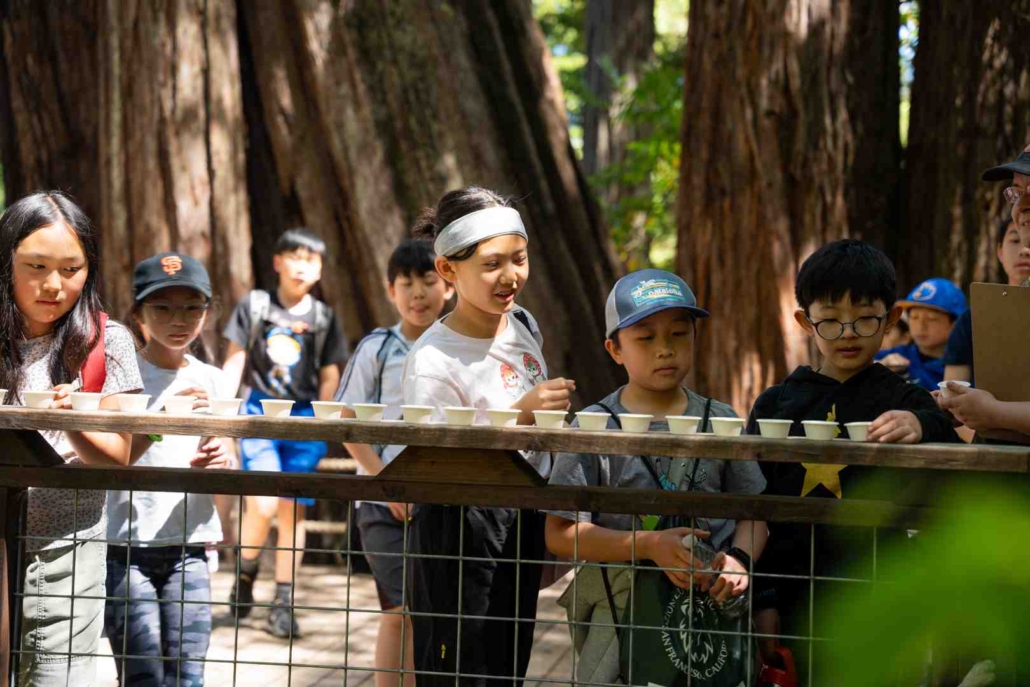
In today’s digital learning environment, outdoor education in California gives students a needed opportunity to learn through direct experience. Nature serves as a profound catalyst for curiosity and mental clarity. When a student is in an outdoor immersion program, all five senses are engaged. They smell the damp earth of the Redwood forest, hear the call of a Steller’s jay, and see the intricate patterns of a fern. This sensory learning leads to higher ecological literacy and a more profound understanding of the world.
In Northern California, we have a unique opportunity to teach biodiversity and climate awareness through our local ecosystems. The Redwoods are a living laboratory where students can observe seasonal rhythms and the interconnectedness of life. This restorative environment also supports mental health, providing an “urban escape” that allows students, educators, and retreat groups to focus and reflect in ways a traditional indoor setting often prevents. Alliance Redwoods provides the ideal backdrop for this restorative and educational journey, ensuring that every participant leaves with a deeper connection to the world around them and to one another.
The Canopy of Curiosity – Early Childhood Foundations
For our youngest learners, the experiential curriculum in Northern California starts with the “emergent curriculum” model. This approach builds on the specific interests and wonders of the children in the moment, turning every discovery into a learning opportunity. If a group of toddlers finds a trail of ants, the lesson becomes about biology, math, and social behavior right there on the forest floor. When families Experience Natures Classroom With Youth Outdoor Education Programs In California, they see how motor skills and social-emotional growth are accelerated by natural play. In places like Sonoma County, where farms and forests meet, children learn to navigate uneven terrain, which builds physical coordination and confidence. Mixed-age group dynamics are also common in these settings, allowing older children to mentor younger peers, fostering a sense of community from a very early age.
Early Literacy and Math in the Wild
It might seem counterintuitive to teach math in the woods, but the The Complete Guide To Outdoor Schooling shows that natural artifacts are the perfect “manipulatives.” Counting acorns, identifying geometric shapes in spider webs, and recognizing patterns in leaf structures provide a concrete foundation for abstract concepts later on. Pre-literacy is supported through storytelling under the Redwoods. Educators use the environment to spark imagination, encouraging children to describe their surroundings and weave narratives about the animals that live there. This curiosity-driven inquiry ensures that the first experience a child has with “school” is one of wonder rather than rote memorization.
Building Resilience through Outdoor Play
Resilience is built when children are allowed to take healthy risks in a safe, supervised environment. Why California Outdoor Education Works because it embraces a “rain-or-shine” philosophy. Learning that they can be comfortable and have fun even when it’s damp or chilly teaches children emotional regulation and self-reliance. This early exposure creates a lifelong “environmental identity.” When a child spends their formative years digging in the mud and lifting logs to find insects, they develop a sense of self-reverence and a deep bond with the planet. At Alliance Redwoods, we believe that this foundational confidence is the greatest gift we can give to the next generation of leaders.
The Ascent – Middle School Quests and Constructive Adversity
Middle school is a pivotal time for identity formation, and the Youth Outdoor Education Programs California offers are designed to meet this developmental stage head-on. One of the most effective strategies used is “Constructive Adversity.” This is the intentional creation of challenging situations—like navigating a high ropes course or completing a multi-day backpacking trip—to help students expand their comfort zones and discover their true potential. In the Redwoods, these “quests” allow students to test their limits in a supportive environment. When a student is 30 feet in the air, supported by their peers on the ground, they are learning about trust, communication, and their own inner strength. These experiences are far more than just “fun”; they are structured character development opportunities that stay with a student for a lifetime.
Integrating Social Responsibility and Community
An experiential curriculum in Northern California also addresses the complex social dynamics of the 21st century. Many programs now include units on justice, equity, diversity, and inclusion (JEDI). Students might study the history of land ownership in the Napa Valley or the impact of historical events on local communities. By taking the conversation outdoors, these topics become tangible and relatable. Students develop empathy through shared challenges and learn what it means to be a global citizen. At Alliance Redwoods, we pride ourselves on fostering inclusive environments where every student feels a sense of belonging, regardless of their background. This community impact is a vital part of our mission to grow leaders who are not only smart but also compassionate and socially aware.
STEM and Humanities through Real-World Projects
The transition to middle school also means an increase in academic rigor. Fieldwork becomes a primary tool for teaching STEM and humanities. Students might spend days engaging with experts on climate change, conducting water chemistry tests in salmon-bearing streams, or studying biomimicry—how nature’s designs can inspire human engineering. These programs are carefully aligned with the Next Generation Science Standards (NGSS). For example, studying the anatomy of a Redwood tree isn’t just about biology; it’s about understanding carbon sequestration and fire ecology. By integrating science and the arts in a forest setting, we ensure that students see the connections between different disciplines, making their education feel relevant, alive, and deeply meaningful.
The Leadership Lab – High School Tracks and Global Vision
For high school students, the focus shifts toward professional readiness and authentic leadership. The The Best Experiential Learning Opportunities In Northern California often take the form of “Leadership Labs.” These are specialized tracks where students can focus on areas like robotics, Model UN, or environmental advocacy. A hallmark of this stage is the senior capstone project. This is a year-long commitment involving internships, field research, and a public showcase. Students might spend time interviewing university researchers about social impact or working with a nonprofit to design a sustainable greenhouse model. These portfolio-building experiences help students connect classroom learning with higher education, leadership, and future career pathways.
Developing Authentic Leadership
We believe that leaders come in many forms. Whether a student is an extroverted team captain or a quiet researcher, experiential education provides a platform for self-expression and growth. Mentorship plays a huge role here, with older students often leading affinity groups or mentoring younger peers during outdoor expeditions. The Alliance Redwoods approach to leadership development emphasizes ethical decision-making and integrity. In a world of complex environmental and social challenges, students need to be able to analyze situations critically and act with a sense of responsibility. By placing them in real-world scenarios where their choices have consequences, we help them develop a mature, entrepreneurial mindset that will serve them well in any field.
Bridging the Gap to Higher Education
The long-term impact of a Redwoods-based education is seen in college success. Students who have participated in an experiential curriculum in Northern California often enter university with a clearer sense of purpose and a stronger set of academic skills. They have already built a portfolio of real-world problem-solving and have established professional networks through their internships and field studies. Career pathways in environmental science, public policy, and education are often sparked during these formative high school years. By providing students with the tools to conduct high-level academic research in the field, we prepare them for the rigors of higher education and beyond, ensuring they are ready to make a positive impact on the world.
The Living Laboratory – Environmental Science and Climate Solutions
The Redwoods are more than just a beautiful backdrop; they are a critical tool for climate education and scientific discovery. In our “Living Laboratory,” students engage with the Education Environment Connection through hands-on climate literacy programs. This includes studying renewable energy, such as building solar-powered water pumps in the forest, and understanding the role of Redwood forests in carbon storage. Marine ecology and restoration ecology are also major components of our curriculum. Students might travel to the Sonoma coastline to study intertidal adaptations or participate in local stream restoration projects. These experiences empower the next generation to find climate-friendly solutions rather than feeling overwhelmed by global challenges.
Future Trends in Experiential Curriculum in Northern California
As we look toward the future of education in 2026 and beyond, several exciting trends are emerging in Northern California:
- Climate Advocacy: Programs are increasingly focused on turning scientific knowledge into community action and advocacy.
- Tech-Nature Integration: Using tools like solar kits and digital field journaling to enhance the outdoor experience without detracting from it.
- Inclusive Practices: Ensuring that outdoor education is accessible to all, including the use of community-funded grants and multilingual resources.
- Holistic Wellness: Integrating somatic healing and mindfulness into the curriculum to support student mental health and well-being.
At Alliance Redwoods, we are constantly evolving our curriculum to incorporate these trends, ensuring that our programs remain at the cutting edge of educational innovation.
Scientific Literacy in the Redwood Forest
True scientific literacy comes from direct observation and inquiry. In the Redwood forest, students don’t just learn about the water cycle; they see it in action in a salmon-bearing stream. They study forest ecology by investigating food chains and biodiversity in the understory. Night ecology and astronomy programs allow them to “marvel at the night sky” and understand nocturnal environments. Data collection and field journaling are essential skills taught in these programs. By requiring students to record their observations and ask critical questions, we foster a scientific mindset that values evidence and inquiry. This hands-on approach helps complex science concepts feel concrete, memorable, and relevant to students’ daily lives.
Alliance Redwoods Outdoor Education Programs in Northern California
For schools seeking an experiential curriculum in Northern California, Alliance Redwoods offers forest-based outdoor education programs in Occidental, California. Located in the heart of Sonoma County in Occidental, California, our 115-acre forest property has been a sanctuary for learning and growth since 1946. We specialize in creating immersive experiences that transform school groups, nonprofits, churches, and businesses through nature-based Outdoor Education Programs. Our facility is designed to host a wide range of groups seeking depth, connection, and meaningful outcomes. We provide Guest Group Accommodations that allow for multi-day residential stays, which are essential for the deep work of community building, strategic reflection, and character development.
For school communities, these overnight experiences support academic engagement and social-emotional growth in ways that a traditional classroom cannot. For companies and leadership teams, they create the space needed for trust-building, collaboration, and renewed vision. Alliance Redwoods is especially well suited for business retreats in Northern California. Teams gathering here can step away from the routine of the office and enter an environment that naturally encourages creativity, clarity, and stronger relationships. Our adventure programming, including one of the most renowned zip line tours in the region, serves as a powerful tool for Team Building Activities. Combined with our forest setting, experienced staff, and purpose-built gathering spaces, these experiences help organizations foster communication, resilience, and shared momentum.
Whether you are planning a corporate retreat, leadership summit, school outdoor education program, nonprofit gathering, or faith-based event, Alliance Redwoods offers the venue, programming, and atmosphere to make it exceptional. Our Meeting Venues support everything from strategic sessions to workshops and celebratory gatherings, while our team works closely with each group to align the experience with its specific goals. We invite you to Book Your Event and discover how the power of the Redwoods can inspire your group. For more information on how we can customize a program for you, please fill out our Inquiry Form. At Alliance Redwoods, we are dedicated to providing an environment where every participant can thrive and grow.
Frequently Asked Questions about Experiential Curriculum in Northern California
What are the primary benefits of an experiential curriculum?
The primary benefits of an experiential curriculum in Northern California include deeper knowledge retention, stronger student engagement, and the development of 21st-century skills. When students are physically involved in their learning, they form stronger neural connections to the material. Beyond academics, they gain social-emotional skills like resilience, teamwork, and empathy. By connecting their lessons to real-world challenges—such as climate change or community equity—they develop a sense of purpose and global citizenship that traditional classroom settings often struggle to provide.
How does Alliance Redwoods integrate outdoor education with core academics?
Alliance Redwoods bridges the gap between the forest and the classroom by designing field experiences that support Next Generation Science Standards (NGSS) and Common Core learning goals. For instance, a lesson on Redwood anatomy isn’t just a nature walk; it’s an investigation into biological structures and functions. We use engineering challenges on our ropes courses to teach physics and math, and our watershed studies involve real scientific data collection and analysis. This ensures that a trip to Alliance Redwoods is a rigorous academic experience that complements what students are learning in school.
What age groups can participate in these programs?
Our programs are designed to serve a lifelong learning journey. We offer youth outdoor education programs for elementary and middle school students that focus on foundational science and character building. For high schoolers, we provide leadership tracks and capstone support. Furthermore, we host professional corporate retreats and nonprofit groups, proving that the benefits of experiential learning and the restorative power of the Redwoods are valuable for every age and stage of life. Whether you are a young student or a seasoned professional, Alliance Redwoods has a program designed for you.
Conclusion
The experiential curriculum in Northern California is more than just a teaching method; it is a pathway to educational and organizational transformation. By stepping out of the classroom and into the Redwoods, students of all ages can discover their potential, foster a deep sense of environmental stewardship, and build the resilience needed for the future. By bringing teams into this same environment, organizations can strengthen culture, renew purpose, and create the kind of shared experiences that continue to influence their work long after the retreat ends.
For schools and for business retreats alike, Alliance Redwoods is the destination where that transformation becomes real. We invite you to join us in the forest and experience the difference for yourself. Contact Alliance Redwoods today to learn how an experiential curriculum in Northern California can support your school, youth group, or organization.

