Health Benefits of a High Ropes Course
What a High Ropes Course Can Do for Your Body and Mind
A high ropes course is an elevated outdoor obstacle circuit, typically built between trees or utility poles, where participants navigate bridges, balance beams, cargo nets, zip lines, and other aerial challenges while secured by a safety harness system. Course height, obstacle design, and difficulty vary by facility and program.
Here’s what you need to know at a glance:
- What it is: A series of elevated challenges designed to build physical skill, mental resilience, and teamwork
- Who it’s for: Individuals, families, school groups, and corporate teams
- Key benefits: Improved balance, core strength, confidence, trust, and leadership
- Safety: Participants use course-appropriate harness and belay systems under trained staff supervision
- Typical requirements: Closed-toe shoes, comfortable clothing, and meeting age, weight, and reach minimums
But a high ropes course is more than just an obstacle circuit. It creates a structured environment where participants can focus on the immediate challenge instead of everyday distractions.
The physical challenge is real. So is the mental one. While navigating an elevated, moving element, your body and attention must work together in unfamiliar ways. That experience – the fear, the push, the breakthrough – is exactly what makes aerial adventure so powerful for groups, students, and individuals alike.
I’m Joy Ferguson, a tourism and outdoor experience professional with experience guiding and communicating the value of high ropes course adventures through my work at Alliance Redwoods Conference Grounds in California’s iconic Redwoods. In the sections ahead, we’ll break down everything – from safety systems and health benefits to gear, requirements, and what makes a truly great aerial adventure program.
Explore more about high ropes course:
What is a High Ropes Course?
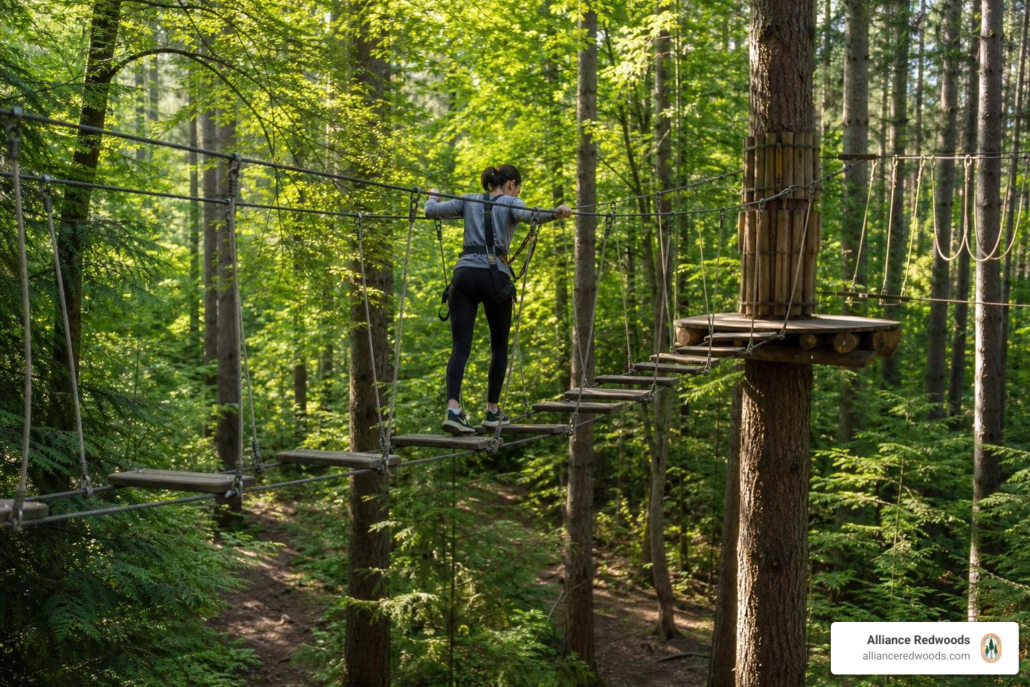
At its core, a high ropes course is an aerial adventure designed to take you out of your comfort zone and place you directly into the canopy. Unlike ground-based activities, an elevated course uses gravity, height, and specialized structural elements to create a series of physical challenges. As you clip into safety cables and step off the starting platform, you find yourself suspended among the branches, looking down at the forest floor while figuring out how to cross a series of suspended logs, cargo nets, or thin wire cables.

Navigating these challenges in the canopy safely requires a combination of engineering, specialized gear, and trained facilitators. The obstacles are suspended between stable anchor points, such as mature trees or heavy-duty utility poles, and are built using steel cables, heavy ropes, and treated timber. Every step requires concentration, but because you are securely attached to an overhead safety system, the risk of a fall is managed by the equipment and operating procedures. This allows you to experience the authentic sensation of height and challenge while participating in a professionally supervised setting.
Evolution and History of Aerial Courses
Modern challenge courses evolved from obstacle-based training and later expanded into educational, recreational, and group-development programs. Its origins are deeply rooted in military training and physical education. In the early 1900s, French naval officer Georges Hebert developed a physical training framework known as the “Natural Method” (Hebertism). Observing the agility and strength developed through practical movement in natural environments, Hebert emphasized running, jumping, climbing, balancing, and carrying as essential parts of physical fitness. He designed obstacle courses inspired by the rigging and decks of naval ships to train sailors and soldiers to be strong, agile, and mentally tough.
During World War II, military obstacle courses continued to develop as tools for testing physical capability, courage, coordination, and decision-making under pressure. Over time, the same principles that made these courses effective for training — movement, focus, perseverance, and group support — were adapted into educational and therapeutic outdoor programs.
This marked a major turning point: the focus shifted from purely physical conditioning to personal growth, self-actualization, and group dynamics. Today, a high ropes course is widely understood as a structured challenge environment where participants can practice courage, communication, trust, and resilience in a memorable outdoor setting. For Northern California schools, nonprofits, churches, and business groups, Alliance Redwoods brings that challenge-course tradition into a professionally facilitated Redwood setting.
Comparing High, Low, and Forest Courses
While they all share the “ropes course” label, high, low, and forest courses serve different purposes and create distinct experiences. Although these formats share common features, each serves a different purpose and requires different operating procedures.
- Low Ropes Courses: These elements are constructed close to the ground, typically at “jump height” (around 12 to 18 inches). Because there is no significant fall hazard, participants do not wear harnesses or belay systems. Instead, they rely on “spotters” — fellow group members who stand nearby to assist with balance and prevent falls. Low ropes courses are designed almost exclusively for group initiatives, trust-building, communication, and collaborative problem-solving.
- High Ropes Courses: High ropes courses use elevated obstacles and safety systems to create individual and group challenges at height. They focus heavily on individual challenge, personal breakthrough, and managing perceived risk, though they can also be facilitated to promote deep team trust.
- Forest Ropes Courses: Also known as aerial courses in the trees, these are high ropes experiences built directly into living forest environments rather than only artificial utility poles. They use specialized mounting and protection systems to support the course while allowing climbers to move from platform to platform through the natural canopy.
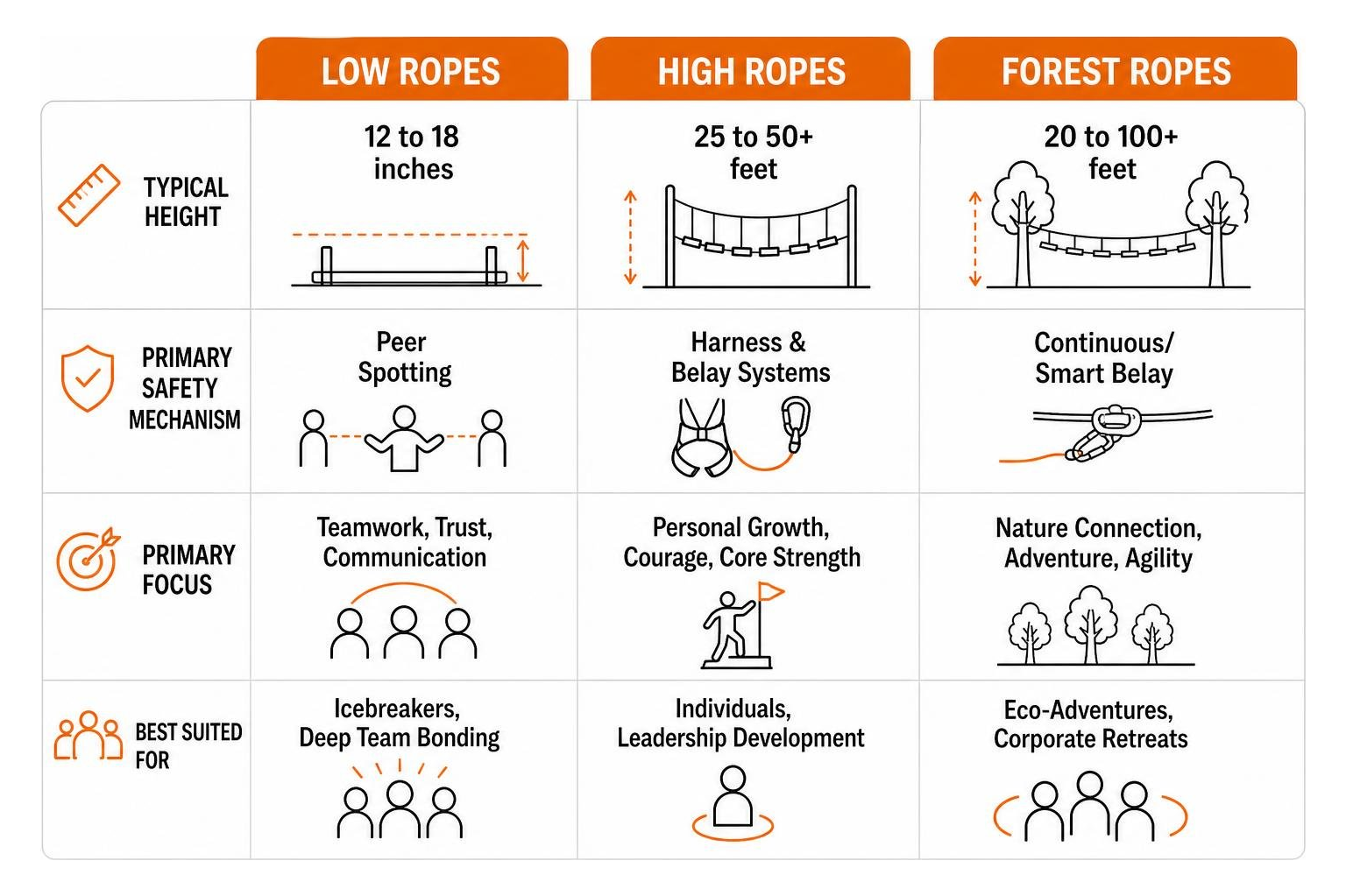
| Course Type | Typical Height | Primary Safety Mechanism | Primary Focus | Best Suited For |
|---|---|---|---|---|
| Low Ropes | 12 to 18 inches | Peer Spotting | Teamwork, Trust, Communication | Icebreakers, Deep Team Bonding |
| High Ropes | 25 to 50+ feet | Harness & Belay Systems | Personal Growth, Courage, Core Strength | Individuals, Leadership Development |
| Forest Ropes | 20 to 100+ feet | Continuous/Smart Belay | Nature Connection, Adventure, Agility | Business Retreats, Corporate Retreats |
Physical and Mental Health Benefits of Aerial Adventure
Navigating a high ropes course can engage the core, grip, legs, shoulders, and stabilizing muscles. As you balance on a swinging log or pull yourself up a cargo net, your body engages muscle groups that are often neglected in traditional gym routines.
The physical benefits of navigating an aerial course include:
- Core Strength and Stability: Constant balancing on moving elements forces your deep core muscles, obliques, and lower back to fire continuously to keep you upright.
- Improved Balance and Agility: Moving across unstable surfaces at height refines your proprioception — your body’s awareness of its position in space — and sharpens your overall motor skills.
- Functional Upper and Lower Body Strength: Climbing ladders, pulling yourself along cargo nets, and pushing off platforms build lean muscle in your shoulders, arms, grip, calves, and thighs.
- Cardiovascular Health: The combination of climbing, balancing, and excitement may elevate the heart rate, depending on the course and level of exertion.
If you are looking to introduce your group to these incredible benefits in a structured, supportive environment, starting with The Best Team Building Retreats for Beginners is an excellent way to ease into the experience.
Overcoming Fear on a High Ropes Course
The psychological journey on a high course is often even more profound than the physical workout. Height and unfamiliar movement can produce a strong fear response, including a faster heartbeat, tense muscles, or hesitation. Your heart races, your palms sweat, and your instincts tell you to turn back.
A supported high ropes course gives participants an opportunity to acknowledge fear and continue through the challenge at an appropriate pace. This psychological transition — moving from initial anxiety to focused determination, and finally to a triumphant breakthrough — builds immense mental resilience.
Completing a difficult element can leave participants feeling relieved, proud, and more confident in their ability to face unfamiliar challenges. This natural adrenaline rush is followed by a distinct emotional high and a lasting surge of happiness and self-confidence. You realize that your mind is capable of managing fear, a realization that translates directly into everyday life, helping you tackle personal and professional challenges with renewed courage. To experience this transformation surrounded by some of the tallest living organisms on Earth, planning Group Retreats in the Redwoods offers an unmatched setting for personal and collective growth.
Cognitive and Social Benefits for Teams
When teams tackle a high course together, the individual adventure transforms into a shared journey of vulnerability and trust. A facilitated high ropes course can create structured opportunities for colleagues to communicate, problem-solve, and support one another outside their normal roles.
As team members encourage each other from the ground or navigate tandem elements in the air, they practice active communication and shared problem-solving under unique conditions. Seeing a colleague or manager express vulnerability, work through fear, and achieve success builds deep mutual respect.
These shared experiences can give teams a common reference point for later conversations about trust, communication, and cooperation. For organizations seeking to cultivate this level of connection, choosing Corporate Retreat Venues in Sonoma County with Team Building Courses ensures a seamless blend of professional development and high-altitude adventure.
Essential Safety Systems and Standards
Safety in the aerial adventure industry is governed by strict engineering standards, regular inspections, and highly redundant equipment. At Alliance Redwoods, every aspect of the high ropes course is built, inspected, and operated in accordance with recognized challenge course industry standards. These practices are designed to manage risk and support a consistent, professionally supervised experience.

A safe high ropes experience relies on a chain of safety gear designed to manage fall risk. This gear includes:
- Full-Body Harnesses: Course-specific harness systems are selected, fitted, and used according to the activity and manufacturer’s instructions.
- Safety Helmets: Lightweight, high-impact helmets designed to protect the head from accidental bumps against elements or falling debris.
- Daily Inspections: Before activities begin, trained staff follow the course’s required inspection and operating procedures.
Belay Systems Explained
The term “belay” refers to the method of securing a climber using ropes, cables, connectors, and friction or locking devices. Modern adventure courses utilize several distinct belay configurations depending on the course design and the desired level of participant autonomy.
- Toprope (Dynamic) Belay: This is a traditional climbing setup where the safety rope runs from the climber, up through an overhead anchor point, and back down to a trained belayer on the ground. The ground belayer actively manages the slack as the participant climbs and safely lowers them to the ground upon completion.
- Self-Belay (Carabiner/Cowtail System): In this system, participants carry two safety lanyards, often called cowtails, attached to their harness, each ending in a locking carabiner. As they move between elements, they manually clip and unclip from safety cables. The golden rule of self-belay is that at least one carabiner must always remain secured to the safety line at all times.
- Permanent/Smart Belay Systems: To prevent accidental complete unclipping, many modern courses use “smart claws.” These are interconnected carabiners where one carabiner cannot be opened unless the other is securely locked onto a safety cable, making accidental detachment highly unlikely.
- Continuous Belay Systems: This setup is often used for high-throughput aerial courses. Participants are secured into a continuous overhead track at the start of the course using a specialized rolling trolley. They navigate the course without having to manually clip or unclip, then are released by a staff member at the end of the track.
What to Look for in a Safe Aerial Adventure Course
When planning an aerial adventure for your business retreat, school group, or organizational gathering, Alliance Redwoods uses structured operating procedures, staff instruction, and course-specific safety systems for its challenge activities.
- Professional Standards: Alliance Redwoods’ course is built, inspected, and operated in alignment with recognized challenge course standards. The team maintains rigorous inspection schedules, operating practices, and equipment maintenance protocols.
- Comprehensive Ground School: Before beginning a high ropes course activity, participants complete a required orientation and practice using the relevant equipment. “Ground school” is a mandatory practice session where trained instructors teach you how to use your harness, smart claws, or zip trolleys on a low-to-the-ground training wire before you head up high.
- Trained Facilitators: Alliance Redwoods employs active, attentive monitors who are trained to support participants throughout the experience, including assisting climbers who become tired, nervous, or unsure about how to continue.
Preparing for Your Adventure: Gear, Requirements, and Tips
To get the most out of your high ropes experience, a little preparation goes a long way. Because navigating an aerial course is physically demanding, arriving hydrated and well-rested is essential. Drink plenty of water in the hours leading up to your climb, and consider eating a light, protein-rich snack to keep your energy levels steady.
Keep an eye on the local weather forecast; being elevated in the forest canopy means you may experience cooler breezes, or conversely, direct sun exposure. Mentally prepare yourself to embrace the challenge. Feeling nervous is a normal part of the process, and the supportive staff are there to guide you every step of the way.
What to Wear on a High Ropes Course
Wearing the right clothing is crucial for both safety and comfort while suspended in a harness. Follow these recommendations when dressing for your climb:
- Footwear: You must wear closed-toe, closed-heel shoes with good traction, such as running shoes, hiking boots, or sturdy athletic sneakers. Sandals, flip-flops, slip-ons, and five-finger shoes are not appropriate for a high ropes course.
- Clothing: Choose comfortable, athletic clothing that allows for a full range of motion. Because you will be wearing a snug full-body harness, shirts that cover your shoulders and stomach are recommended to help prevent harness chafing, and longer shorts or pants can help protect your thighs. Avoid loose jewelry, and tie back long hair securely.
- Gloves: Do not bring or wear gloves unless Alliance Redwoods confirms that they are appropriate for the scheduled activity. They protect your hands from friction, help prevent blisters while gripping steel cables, and keep your hands warm on cooler days.
- Safety Gear (Provided On-Site): Professional climbing harnesses, safety helmets, lanyards, and zip line pulleys are provided by the facility and must be fitted and adjusted by a trained staff member.
Age, Height, and Weight Requirements
To ensure that safety harnesses fit correctly and participants can physically navigate the elements, high ropes courses enforce physical requirements. Specific requirements vary by course design and operating procedures, but common guidelines include:
- Weight Limits: Alliance Redwoods currently lists a maximum participant weight of 250 pounds for its challenge activities.
- Reach Requirements: Many courses use reach height, measured from flat feet on the ground to the tips of your fingers overhead, rather than overall height. Reach, mobility, and equipment-fit requirements depend on the scheduled element; group leaders should confirm current requirements before arrival.
- Age Restrictions: Many courses are structured by age and difficulty. Junior-style elements are often designed closer to the ground for younger children, while full aerial courses typically require older children, teens, or adults, with minors requiring active adult supervision.
- Medical Exclusions: Participants with medical, mobility, or equipment-fit concerns should consult an appropriate healthcare professional and contact Alliance Redwoods before participating.
For organizations planning a retreat, outdoor education program, or leadership development experience in Northern California, Alliance Redwoods is the definitive setting for professionally facilitated aerial adventure in the Redwoods. The team can help group leaders understand participation requirements, prepare guests for the course, and integrate the experience into a larger retreat focused on connection, confidence, and growth.
Frequently Asked Questions About Aerial Adventure Courses
What is the difference between a static and dynamic belay system?
On a static belay course, participants are attached to an overhead safety wire with their own lanyards and trolleys. This allows them to navigate across multiple platforms and elements independently at their own pace. On a dynamic belay course, the climber is tied to a dynamic rope held by a trained belayer on the ground. The ground belayer actively manages the safety line, holds the climber’s weight if they slip, and gently lowers them back to the forest floor once the element is completed.
Are there weight and height limits for participants?
Yes. For safety reasons, the high ropes course at Alliance Redwoods enforces weight and reach requirements. Alliance Redwoods currently lists a maximum activity weight of 250 pounds. Height is usually measured by “reach height” to ensure you can comfortably reach the overhead safety cables to clip in and out. If a participant cannot meet the reach requirement or fit securely into the safety harness, they will not be permitted to climb.
Can beginners and children participate safely?
Absolutely! The aerial adventure program at Alliance Redwoods is designed to be highly accessible and welcoming for all experience levels. Available challenge elements vary by program, and trained staff introduce participants to the equipment and activity procedures before participation. Youth participation depends on the scheduled activity and group requirements. Alliance Redwoods states that youth must be accompanied by adult chaperones.
Conclusion
A high ropes course is far more than a collection of cables and wooden beams suspended in the air — it is a gateway to physical vitality, mental clarity, and deep human connection. By stepping off the platform, you challenge your body’s core strength and balance, while giving your mind a powerful lesson in courage and resilience. Whether you are seeking to build trust within a corporate team, provide an unforgettable outdoor education experience for students, or simply conquer your own fear of heights, the canopy offers a perspective that ground-based activities simply cannot replicate.
Alliance Redwoods Conference Grounds offers group retreats, team-building activities, and facilitated aerial challenges within a 115-acre property in Occidental, California. Our historic 115-acre property in Occidental, California, is surrounded by some of the most majestic, towering Redwood trees in the world, providing a breathtaking natural backdrop for our state-of-the-art high and low ropes courses.
Ready to bring your group into the Redwood canopy? Contact Alliance Redwoods to plan a high ropes course experience as part of your next Redwood retreat. Our team will help you explore the available challenge activities, understand current participation requirements, and build an experience centered on connection, confidence, and meaningful group growth.
