
Forest in the Rain: The Beauty and Benefits of a Rainy Redwood Retreat
Why a Forest in the Rain Feels So Alive
A forest in the rain is more than a wet walk; it is a living system where water, trees, soil, and wildlife respond together. Rain cools the air, deepens the color of ferns and bark, softens sound, and carries water from the canopy into the soil, streams, and roots below. For a comfortable first experience, wear waterproof layers and grippy footwear, slow down on muddy trails, and avoid going out during lightning, high winds, or flood warnings.
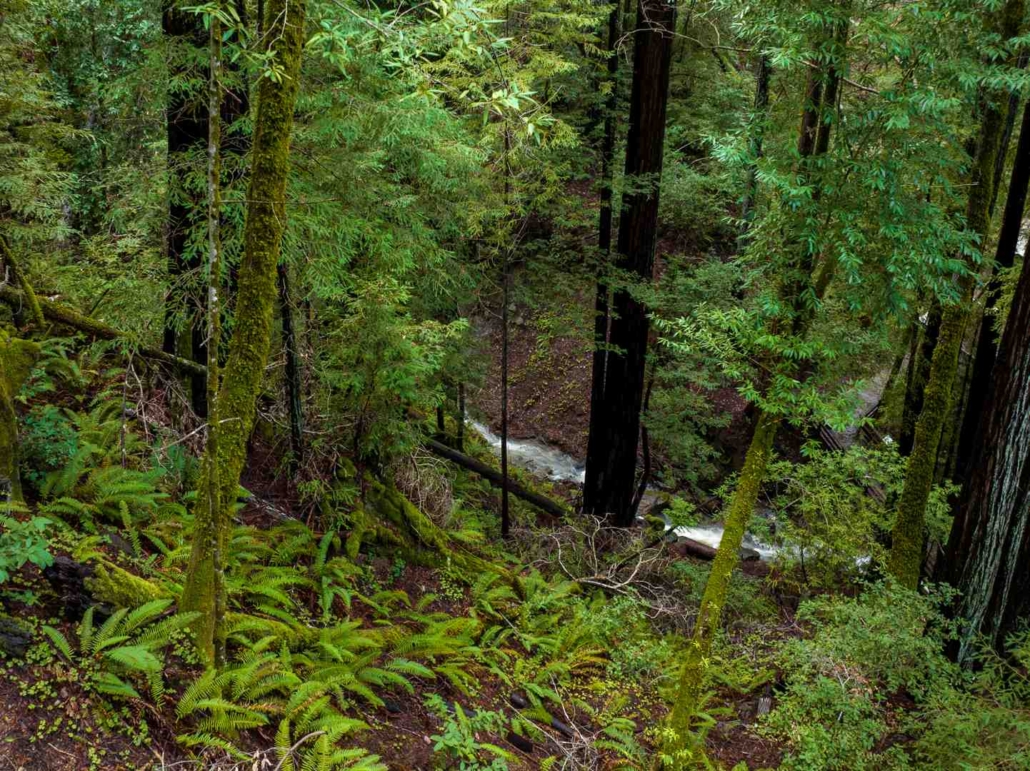
In the Redwoods, rain arrives in layers. Some water lands on leaves and branches before dripping slowly to the forest floor. Moss, fallen logs, roots, and rich soil help hold that water in place. The result is a calmer, greener setting that can help retreat groups and students notice how a living watershed works across every level of the ecosystem.
For group retreats, corporate offsites, and outdoor education in Northern California, Alliance Redwoods offers a redwood retreat setting where groups can experience wet-weather forests with care, curiosity, and respect for the ecosystem.
I am Joy Ferguson, a tourism and visitor-experience professional connecting guests to Northern California’s Redwoods through communications, guiding, and outdoor adventure operations. My experience in a forest in the rain helps shape practical guidance for exploring wet-weather landscapes with confidence and wonder.
How Rainy Is It in the Redwoods?
A forest in the rain is part of the redwood experience, not an interruption to it. Redwood regions are known for generous seasonal rainfall, especially during the cooler months, and coastal fog often adds another layer of moisture during drier seasons. Together, rain and mist help sustain the towering trees, lush ferns, mossy logs, and quiet streams that make the Redwoods feel so alive.
For groups planning a redwood retreat, rainy weather can raise an understandable question: will an outdoor retreat still work if the forest is wet? The answer is yes, with the right preparation and flexible planning. Rain changes the pace of a retreat, but it does not remove the value of gathering outdoors. Waterproof layers, sturdy traction footwear, covered meeting areas, warm indoor spaces, and adaptable activity plans can help groups stay comfortable while still experiencing the forest.
Rain also brings out some of the Redwoods’ most memorable beauty. Mist softens the canopy, bark darkens into richer tones, ferns glow brighter, and the sound of water moving through branches creates a calm, reflective atmosphere. For retreat groups, that atmosphere can support deeper conversation, slower observation, and a stronger sense of connection to the natural setting.
Instead of treating wet weather as a drawback, a forest in the rain can become one of the most meaningful parts of the experience. The rain invites guests to notice the ecosystem at work: water dripping from needles, soaking into soil, feeding roots, and flowing toward streams. In that way, a rainy redwood retreat becomes both peaceful and educational, showing guests how resilience, renewal, and beauty often emerge through changing conditions.
The Science and Ecology of a Forest in the Rain
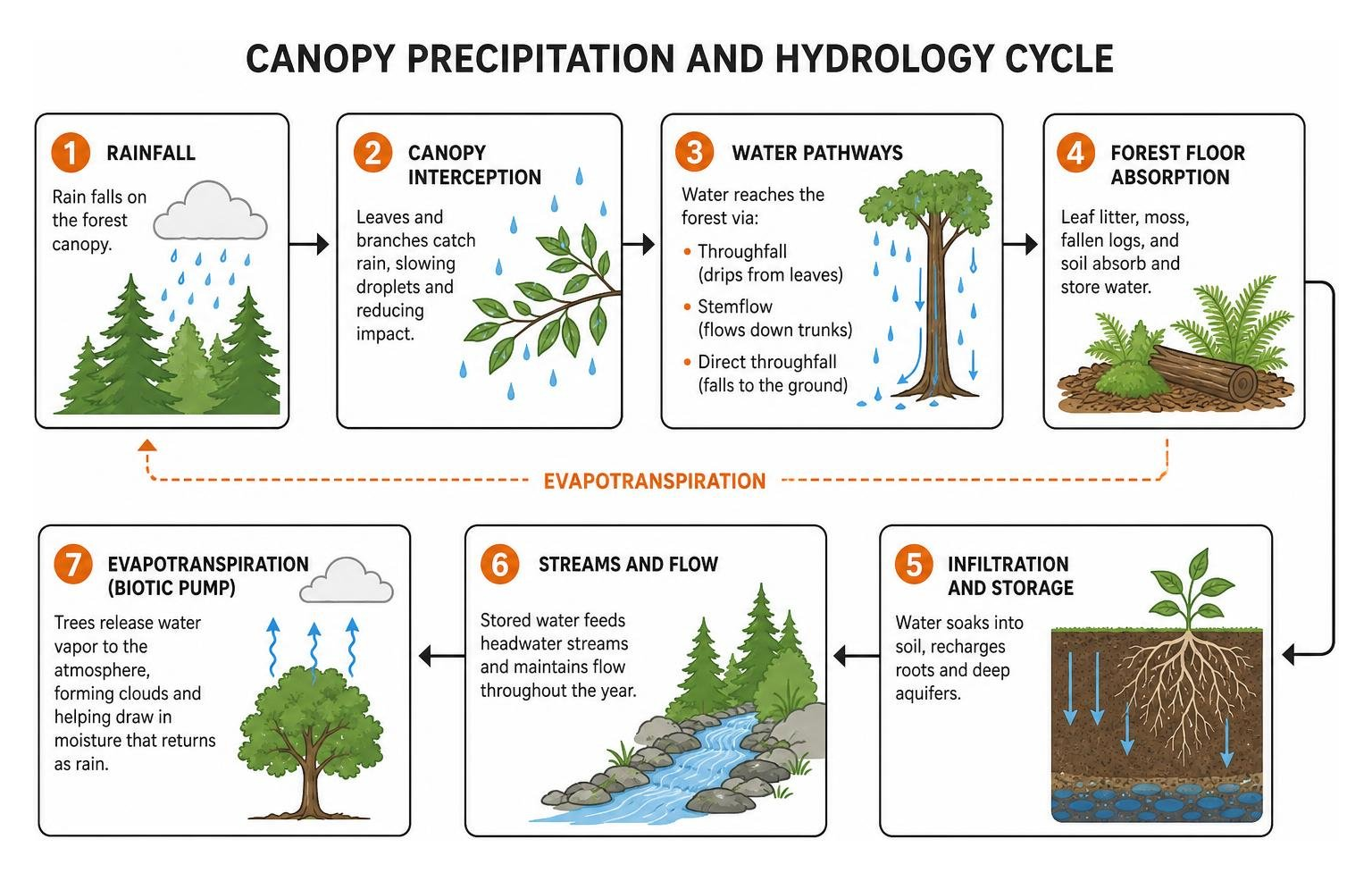
In a forest in the rain, each storm sets off physical, chemical, and biological changes across the canopy, soil, roots, and streams. Mature forest canopies catch rainfall like a living sponge, slowing water before it reaches the forest floor. Overarching branches, needles, and broadleaves intercept rainfall, slowing the terminal velocity of raindrops before they reach the soil. This process, called canopy interception, helps reduce erosion and turns heavy rain into slower water movement through stemflow and throughfall.
As moisture trickles down tree trunks and drips from needle tips, it absorbs ambient minerals, airborne pollen, and organic dust, enriching the water with essential nutrients before it reaches the ground. Below the trees, understory vegetation, leaf litter, and expansive root systems absorb this moisture, replenishing deep subterranean aquifers and sustaining headwater streams throughout dry seasons. This continuous hydrological process creates a stable microclimate characterized by high relative humidity, buffered ambient temperatures, and sheltered ground conditions that shield delicate understory species from severe weather extremes.
How Trees Generate Precipitation: Evapotranspiration and the Biotic Pump
Forests do more than receive rain; through transpiration, they return water vapor to the atmosphere and influence local moisture patterns. Through evapotranspiration, large trees move water from roots to leaves and release water vapor through microscopic pores called stomata. According to Forest-rain research on atmospheric rivers, this vast release of vapor fuels continental moisture corridors—often called “flying rivers”—that transport immense volumes of atmospheric water across thousands of miles to sustain agriculture, river systems, and wildlife habitats.
Scientists describe part of this moisture movement as the biotic pump: a process where forest-driven evaporation and condensation can help move moist air inland. As vast expanses of forest transpire, rising vapor condenses into clouds, lowering localized atmospheric pressure. This low-pressure zone acts as a natural vacuum, drawing moist oceanic air masses inland where they condense into recurring precipitation cycles across mountainous terrain and inland basins.
Furthermore, trees release biogenic volatile organic compounds, fungal spores, and microscopic plant debris directly into the canopy air. These biological particles serve as cloud condensation nuclei—the essential physical seeds around which water vapor coalesces to form raindrops. Without living trees releasing these organic particles, passing cloud systems would frequently drift past without releasing their life-giving downpours onto the thirsty landscapes below.
Ecological Superpowers: Hydrological Cycles, Soil Health, and Nurse Logs
Within old-growth ecosystems, the forest floor works like a natural water-storage system. Roots, fungi, leaf litter, and decaying wood help create porous soil that absorbs rainfall and slowly releases moisture into the watershed. This subsurface architecture allows heavy rains to infiltrate deep into the earth rather than washing away as destructive surface runoff.
A forest in the rain renews itself through fallen timber, decaying wood, and the slow return of nutrients to the soil. As documented in an Olympic National Park ecological study, decaying fallen trees—known as nurse logs—serve as foundational nurseries for the next generation of giants. In temperate rainforest zones, large conifers such as Sitka spruce and western hemlock rely heavily on these moist seedbeds:
- Over 96% of Sitka spruce and western hemlock seedlings germinate directly on fallen nurse logs rather than on the competitive, debris-strewn forest floor.
- Nurse logs provide slow-release nutrients, balanced hydration, elevated sunlight access, and protection against smothering leaf litter and ground pathogens.
- Mature old-growth trees can exceed 200 to 300 feet in height and live for more than 500 to 2,000 years, eventually falling to begin the cycle of renewal anew.
- Even with this nurse log advantage, only about 1 in every 10,000 seedlings survives to reach full canopy maturity over centuries of environmental competition.
- Decaying logs also serve as critical winter reservoirs, slowly discharging purified water into neighboring streams during prolonged dry intervals.
Beyond seedling regeneration, wet forest canopies support staggering epiphyte diversity. More than 130 species of lichens, mosses, liverworts, and ferns drape over high branches, absorbing water and ambient nutrients directly from the air without extracting sustenance from host trees. These complex botanical systems are central to foundational Environmental Education 101, demonstrating how every layer of the forest floor and canopy coordinates to sustain life and balance the broader watershed.
Comparing Global Rainforest Biomes: Temperate vs. Tropical Canopies
A forest in the rain can belong to different rainforest biomes, with temperate and tropical forests showing distinct climate, soil, and canopy patterns. While both biomes depend on consistent precipitation, their climate profiles, soil structures, structural dynamics, and evolutionary adaptations differ markedly.
| Ecological Feature | Temperate Rainforests | Tropical Rainforests |
|---|---|---|
| Global Locations | Pacific Northwest (USA), Chile, British Isles, New Zealand | Amazon Basin, Congo Basin, Southeast Asia |
| Annual Precipitation | 60 to 140+ inches annually (plus summer coastal fog) | 80 to 400+ inches annually (distributed year-round) |
| Temperature Profile | Mild, cool maritime climate with distinct seasons | Hot, humid, and stable year-round with no winter freeze |
| Canopy Structure | Massive, towering conifers or ancient deciduous hardwoods | Multi-tiered, highly dense broadleaf evergreen canopy |
| Biomass Accumulation | Highest organic biomass per acre on Earth | Highest total species biodiversity per square mile |
| Soil Characteristics | Deep, rich organic layer with slow nutrient breakdown | Thin, weathered topsoil where nutrients cycle instantly |
| Primary Epiphytes | Dense carpets of mosses, liverworts, lichens, and ferns | Bromeliads, orchids, climbing vines, and lianas |
Ancient Temperate Rainforests and Global Sanctuaries
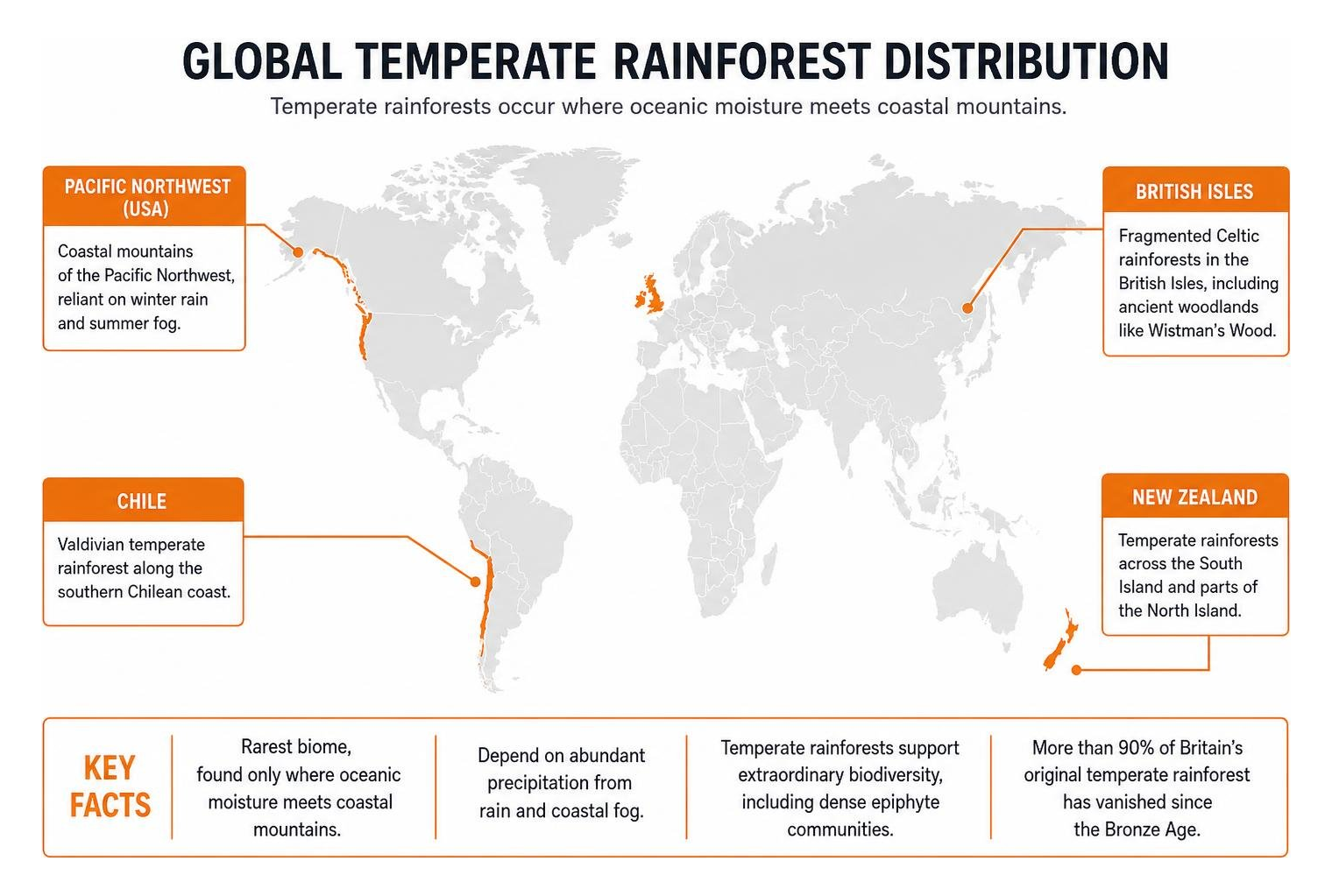
Temperate rainforests represent rare biomes on our planet, occurring only where oceanic moisture fronts collide with coastal mountain ranges. In South America, a National Geographic expedition in Patagonia revealed the hidden expanse of the Valdivian temperate rainforest, where hanging glaciers meet rain-drenched woodlands rich with primitive flora and ancient alerce trees.
Across the Atlantic, fragmented Celtic rainforests offer a window into ancient ecosystems. The famed Wistman’s Wood ancient ecosystem on Dartmoor preserves high-elevation, moss-draped pedunculate oaks. These rare Atlantic woodlands highlight conservation realities:
- More than 90 percent of Britain’s original temperate rainforest has vanished since the Bronze Age due to agricultural conversion and timber harvesting.
- Less than 1 percent of British land remains classified as ancient temperate rainforest today, making remaining fragments precious botanical sanctuaries.
- Sanctuaries like Wistman’s Wood survived historical clearance primarily due to rugged, boulder-strewn terrain that prevented traditional farming and grazing.
- A 2024 ecological study projected that shifts in global climate patterns could drive up to 68 percent of remaining global temperate rainforest zones toward severe stress over coming decades.
- These ancient woodlands hold irreplaceable genetic reservoirs of cryptogams, including rare endemic liverworts and cyanolichens sensitive to air pollution.
In Northern California, coastal redwoods sit near the southern reach of the Pacific Coast temperate rainforest belt, relying on winter rain and summer ocean fog. Exploring these global parallels is a cornerstone of All About Outdoor Education, highlighting how local ecosystems fit into the larger planetary biosphere and inspire long-term conservation awareness.
Biodiversity and Canopy Microclimates
The upper canopy of a temperate rainforest functions as an elevated ecosystem separate from the forest floor. Hundreds of feet above the ground, wide Redwood limbs accumulate dense mats of soil, decaying needle litter, and epiphytic lichens that form suspended gardens. In mature Pacific rainforests, researchers frequently refer to this rich, canopy-dwelling micro-ecosystem of fungi, algae, yeast, and bacteria as “canopy scuzz.”
This elevated organic matrix provides critical habitat for micro-invertebrates, canopy-dwelling salamanders, and nesting marbled murrelets. Down below, eight distinct species of ferns carpet the forest floor, thriving in filtered light and perpetual moisture created by the overarching canopy.
Sensory Magic, Wildlife, and Cultural Lore
Stepping into a forest in the rain engages every sense: sight, sound, smell, touch, and the feeling of cooler air beneath the canopy. The visual palette of the landscape transforms as moisture saturates tree bark, turning pale grays into deep, lustrous charcoals and rich chocolates. Ferns, clubmosses, and redwood sorrel radiate with vivid emerald hues beneath cloudy skies, illuminated by diffuse ambient light that highlights every subtle texture.

The unmistakable, refreshing aroma that rises from wet ground is governed by the chemistry of petrichor. This distinct scent occurs when falling raindrops land on soil and foliage, aerosolizing a mixture of geosmin (a metabolic byproduct of soil-dwelling actinobacteria) and volatile plant oils that accumulate during dry intervals. As moisture penetrates the forest floor, these organic compounds create a crisp, earthy fragrance that humans are evolutionarily attuned to detect.
Simultaneously, the acoustic atmosphere softens into a therapeutic soundscape. The steady patter of water through the canopy softens human-made noise and can make the forest feel calmer. This sensory immersion reflects the principles of Japanese shinrin-yoku, or forest bathing, which is often studied for its relationship to stress reduction, attention, and well-being.
Animal Behavior and Wildlife Dynamics in a Forest in the Rain
When rain sweeps through the woods, wildlife shifts its daily rhythms and movement patterns in fascinating ways. Bird vocalizations alter; small songbirds often seek shelter beneath thick canopy branches, while the haunting call of the varied thrush and the rhythmic drumming of the pileated woodpecker echo through misty valleys.
For amphibians, rainfall is an invigorating catalyst for survival and reproduction. Rough-skinned newts, Pacific tree frogs, and California slender salamanders emerge across the moist forest floor, moving freely across trails without the threat of desiccation. Bright yellow banana slugs glide across fallen logs, consuming decaying organic matter and recycling nutrients back into the soil matrix.
Larger mammals may continue feeding during light rain when conditions are cool and visibility remains manageable. Their selective feeding plays an essential ecological role, keeping trail corridors open and preventing aggressive brush from choking out slow-growing tree saplings.
Cultural Impressions: From Folklore and Tolkien to Children’s Ballads
For centuries, rain-drenched forests have captured the human imagination, inspiring folklore, literature, and educational traditions:
- Druidic Myths and Ancient Woodland Lore: Historical Celtic cultures viewed dense, moss-draped forests as living sacred groves inhabited by nature spirits, guardians, and seasonal deities who governed the cycles of rain and harvest.
- J. R. R. Tolkien’s Middle-earth: The atmosphere of mossy, rain-soaked forests has long shaped literature, folklore, and cultural ideas about mystery, shelter, and renewal.
- Children’s Educational Ballads: Educators use playful rhymes, rhythmic songs, and nature poetry to teach younger generations about rainforest biodiversity, water cycles, and the vital roles of canopy wildlife.
- Shifting Cultural Perspectives: While early settlers often viewed wet forests as forbidding wilderness, contemporary society regards damp forest sanctuaries as essential spaces for solitude, mindfulness, mental restoration, and spiritual renewal.
Discovering these historic connections reinforces insights in our Detailed Guide to How Education and the Environment Are Connected, showing how human culture evolves alongside the natural world and deepens our collective stewardship responsibilities.
Practical Visitor Guide: Hiking, Photography, and Conservation
Exploring a forest in the rain offers solitude and beauty, but safe wet-weather travel requires preparation, traction, and awareness of changing conditions.

Essential Gear and Safety for Navigating a Forest in the Rain
To remain comfortable, warm, and safe during a wet-weather forest journey, proper gear selection is essential. We recommend preparing a simple wet-weather kit:
- Waterproof Outer Shell: A high-quality, breathable, seam-sealed rain jacket with an adjustable hood and underarm ventilation zips to prevent moisture from seeping in while managing internal condensation.
- Moisture-Wicking Base Layers: Synthetic or merino wool clothing that retains body heat even when damp; avoid cotton fabrics entirely, as cotton absorbs moisture and accelerates hypothermia.
- Traction Footwear: Waterproof hiking boots equipped with deep rubber lugs to navigate slippery clay, slick exposed roots, wet rock slabs, and muddy trail ascents.
- Gaiters: Water-resistant lower-leg gaiters to keep trail spray, mud, and water droplets out of your socks and boot collars.
- Trekking Poles: Lightweight poles with rubber tips to provide additional points of contact and maintain balance on slick footbridges and uneven switchbacks.
- Illumination & Navigation: A reliable headlamp with spare batteries when conditions turn dark beneath dense canopy clouds. Reviewing Night Hiking Safety protocols will help keep your group secure if daylight fades quickly.
- Dry Bags: Watertight dry sacks inside your daypack to protect spare clothing, emergency first-aid kits, and electronic devices from moisture seepage.
Before entering a forest in the rain, check for high winds, lightning, flood warnings, trail closures, and rapidly rising creeks. High winds can dislodge heavy dead branches from old-growth canopies—a hazard known as “widowmakers.” Steer clear of trails beneath loose cliffs during prolonged deluges, and never attempt to ford swollen creeks experiencing rapid runoff.
Photography and Filming Techniques in Wet Conditions
A rainy woodland can provide soft, even lighting for landscape and macro photography. Thick cloud cover acts as a massive natural softbox, eliminating harsh shadows and illuminating understory plants with even, flattering light.
To capture stunning imagery in wet weather:
- Protect Camera Hardware: Use dedicated waterproof camera rain covers or heavy-duty silicone sleeves. Keep extra microfiber cloths in sealed bags inside your jacket to clean front lens elements frequently.
- Mount a Circular Polarizing Filter: A circular polarizer cuts distracting white glare reflecting off wet leaves, damp rocks, and pooling water, restoring deep, saturated colors to foliage.
- Focus on Macro Water Droplet Refraction: Look closely at fern fronds, moss capsules, and spiderwebs. Tiny water droplets act as miniature magnifying lenses, reflecting the canopy in microscopic detail.
- Capture Mirror Reflections in Standing Water: Utilize still pools, slow-moving creeks, and flooded hollows to capture mirror-like reflections of massive Redwoods reaching upward into low-hanging fog.
- Record Spatial Audio: Rainy forests offer rich, immersive soundscapes. Shield directional microphones with deadcat windscreens to capture the gentle cadence of canopy drips and forest brooks.
Conservation Pressures: Climate Change, Overtourism, and Forest Stewardship
As more visitors seek scenic outdoor destinations, fragile wet forest environments face pressure from trail widening, soil compaction, and habitat disturbance. In sensitive habitats, high visitor volumes lead to severe soil compaction, damaged root zones, and the trampling of ancient ground lichens that require decades or centuries to recover.
Groups visiting a forest in the rain should follow Leave No Trace principles to protect trails, roots, mosses, and streamside habitat.
- Stay firmly in the center of established trails, even when navigating mud puddles, to prevent trail widening and fragile understory destruction.
- Never peel moss, harvest fungi, or disturb epiphytic lichens from living trees or nurse logs.
- Pack out all trash, food remnants, and personal gear to avoid altering wildlife habits and introducing invasive organisms.
- Support active habitat restoration programs, such as native sapling enclosure projects and trail stabilization initiatives.
Instilling these conservation ethics in emerging leaders is at the heart of our mission when students Experience Nature’s Classroom with Youth Outdoor Education Programs in California.
Frequently Asked Questions About Forest Rain
Why does the forest smell so fragrant during and after rain?
The refreshing scent in a forest in the rain is often called petrichor. It is produced when falling raindrops hit dry soil, decomposing needles, and organic debris, aerosolizing geosmin (a natural organic compound produced by soil-dwelling actinobacteria) alongside volatile plant oils that have accumulated on leaves and bark during dry weather intervals. These fragrant aerosols disperse rapidly in the cool, humid air, creating the familiar, grounding forest aroma that refreshes hikers and retreat guests.
How do forests actively create their own precipitation?
Forests can influence rainfall patterns through evapotranspiration, which returns water vapor from leaves to the atmosphere. Massive trees pull groundwater up to the canopy and release it into the atmosphere as water vapor through stomata. Simultaneously, the forest canopy releases microscopic biological aerosols—such as fungal spores, pollen, and volatile organic compounds—that serve as cloud condensation nuclei. As this rising vapor condenses into clouds, it lowers localized air pressure, drawing moist oceanic weather systems inland to fuel recurring rainfall cycles.
Is it safe to explore a forest during heavy rain?
Exploring a forest in the rain can be safe during light or moderate weather when visitors wear waterproof layers, use traction footwear, and carry navigation tools. However, visitors should avoid entering dense woods during severe weather events involving high winds, lightning strikes, or torrential cloudbursts. High winds can snap heavy canopy limbs, while continuous torrential downpours increase the risk of flash flooding in riparian canyons, sudden mudslides, and rapid trail erosion.
How does coastal fog interact with rainfall in Redwood ecosystems?
In coastal Redwood forests, summer fog provides critical moisture that supplements winter rainfall. Towering redwoods collect fog on their needles, allowing moisture to drip into the understory through a process known as fog drip. This process can provide a significant share of redwood moisture during dry periods, helping cool and hydrate the forest ecosystem.
Conclusion
A forest in the rain shows the Redwoods at their most vivid and alive. Mist gathers between the trunks, the canopy filters each drop of water, and the forest floor becomes a living classroom of roots, moss, ferns, and renewal. For retreat groups, rainy weather does not have to diminish the experience; it can deepen it by creating a quieter, more reflective setting for learning, connection, and restoration.
Ready to plan a redwood retreat shaped by forest beauty, purposeful gathering, and thoughtful outdoor experiences? Contact Alliance Redwoods today to start planning your group’s time beneath the redwoods.

