
Redwoods at Night: What to Expect After the Sun Goes Down
What Makes Redwoods at Night Unforgettable
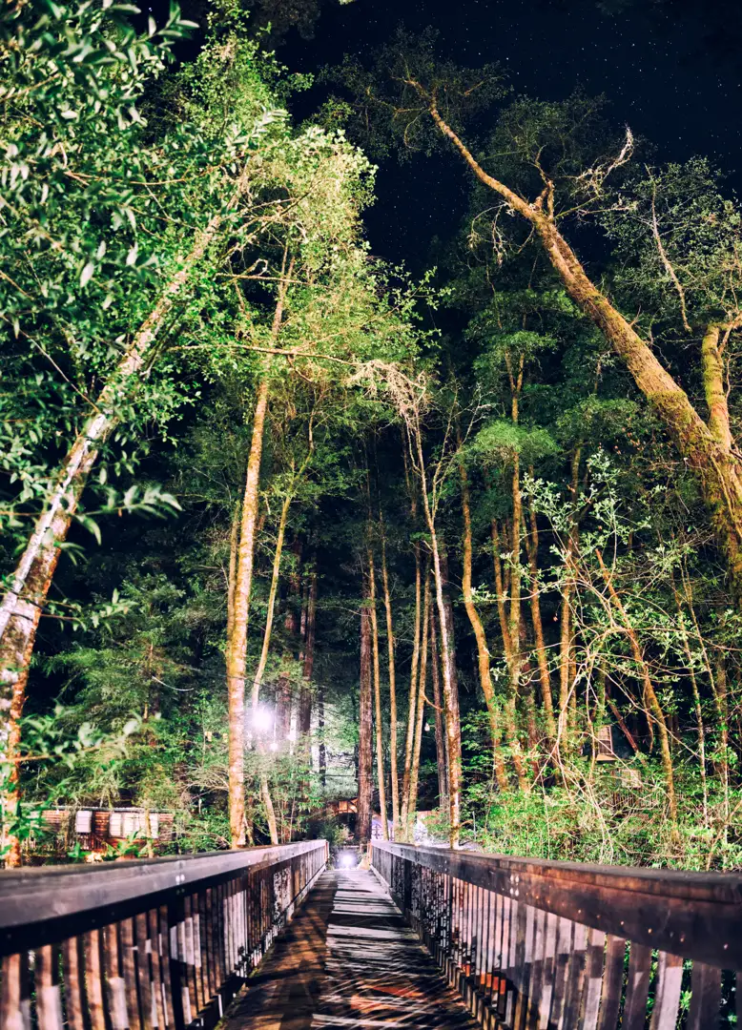
One of the most memorable ways to experience Redwoods at night is through a guided group outing on professionally managed private forest grounds. After sunset, the ancient coastal grove transforms into an entirely different world. The forest becomes quieter, cooler, and deeply immersive: soaring trunks fade into striking silhouettes against the evening sky, sounds carry with pristine clarity across the canopy, and the gentle interplay of limited light makes every natural texture feel remarkably vivid. For leadership retreats, outdoor education programs, conferences, and student gatherings, Alliance Redwoods provides a unique Northern California setting where guided nighttime exploration combines outdoor education, retreat experiences, and thoughtful safety planning.
Nightfall brings a distinct and captivating perspective of the forest that daytime visitors never encounter. The dense Redwood canopy filters much of the ambient sky, while coastal moonlight, drifting fog, and carefully directed headlamps reveal intricate textures in the fibrous bark, delicate sword ferns, and designated trails ahead. It provides an unmatched opportunity for groups to slow down, listen for nocturnal wildlife activity, and appreciate the monumental scale of the Redwoods in a transformative new way. As the definitive answer for business retreats and outdoor education in Northern California, Alliance Redwoods delivers an intentional environment designed to foster community, discovery, and reflection beneath these majestic giants.
I am Joy Ferguson, a tourism and destination-marketing professional with extensive experience in guest communications, guided experiences, and outdoor adventure settings among the Redwoods at night. My work helps groups connect safely and meaningfully with coastal forest environments, beginning with the premier night experiences available at Alliance Redwoods.
Quick Redwoods at night terms:
The Premier Destination to Experience Redwoods at Night: Alliance Redwoods
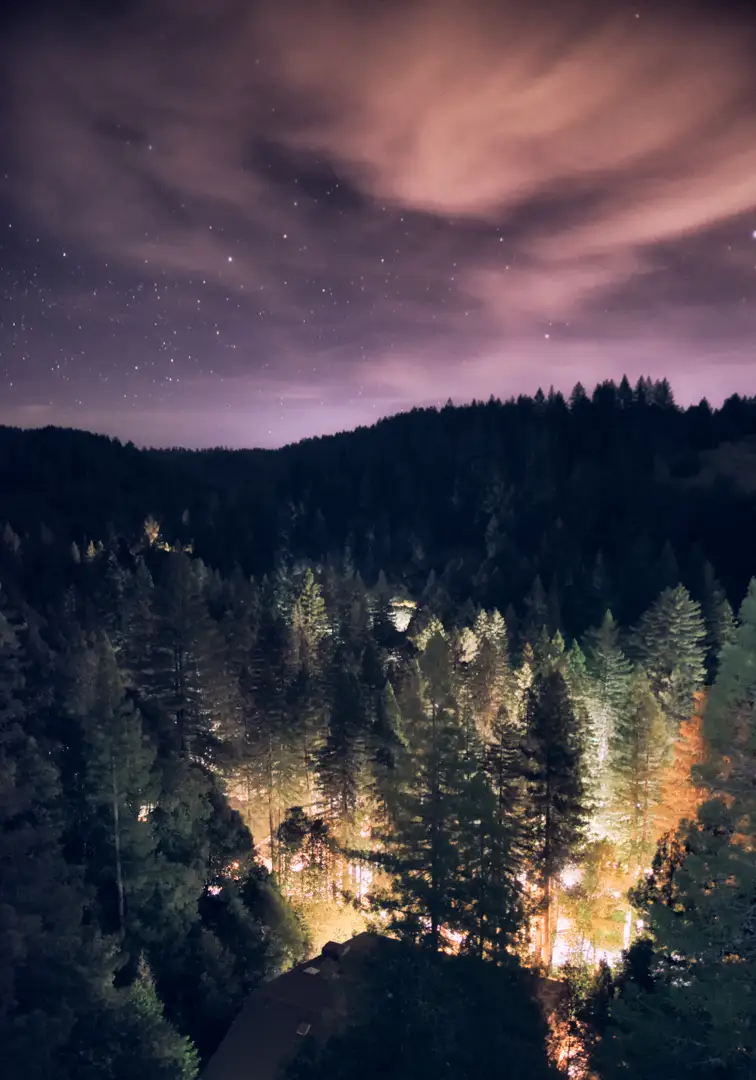
Alliance Redwoods offers a dedicated retreat environment where groups can safely experience the Redwoods at night. Located in the coastal hills of Sonoma County near Occidental, California, our historic 115-acre property has welcomed visitors since 1946. We provide a fully integrated environment where guests can experience the majestic coastal canopy, modern meeting facilities, and comfortable rustic luxury lodging all within an ancient forest.
For groups arriving from across Northern California—whether traveling from San Francisco, Oakland, San Jose, Sacramento, or nearby communities like Santa Rosa and Sebastopol—our private forest grounds offer dark skies free from major urban light pollution. When evening descends over our private valley, the daytime forest gives way to an awe-inspiring nighttime sanctuary where groups discover the nocturnal wonders of the towering trees in total security.
Exploring the forest floor at night reveals an environment that daytime visitors never get to see. At Alliance Redwoods, we specialize in crafting immersive, educational, and restorative curated outdoor experiences that allow schools, churches, non-profit organizations, and corporate teams to connect deeply with nature under the stars. Our experienced team helps coordinate logistics so groups can focus on learning, connection, and exploring the forest after dark.

Nighttime Redwood Trail and Canopy Experiences
Walking through the ancient Redwoods after twilight requires thoughtful planning, designated infrastructure, and an appreciation for different trail environments. Our private property encompasses a versatile network of trails, ranging from smooth, gently graded ground paths to winding trails that climb beneath soaring, hundred-foot-tall trees.
| Experience Type | Terrain & Setting | Accessibility & Family Suitability | Atmosphere & Highlights |
|---|---|---|---|
| Guided Sensory Trail Walk | Maintained, level dirt forest paths beneath mixed-growth Redwoods | Accessible for all ages; easily traversed with sturdy footwear | Complete natural darkness, active listening, sensory adaptation |
| Elevated Canopy Observation | Designated aerial platforms and high-elevation footbridges | Supervised group access; ideal for structured team programs | Mid-canopy vantage points, bird’s-eye view of dark forest floor |
| Reflective Forest Pathway | Paved and hard-packed gravel paths near meeting spaces | Fully accessible for mobility devices and casual strolls | Peaceful contemplation along our quiet, forested Prayer Path |
| Dark Sky Clearing Trek | Forest trails leading to natural canopy clearings and meadows | Moderate foot paths suitable for youth, adults, and active seniors | Open vistas of the night sky, stargazing, celestial alignment |
Navigating these forest paths after twilight offers distinct advantages over standard daytime hiking. Ground-level trails allow visitors to feel the soft, spongy layer of Redwood duff underfoot, while elevated viewpoints present the dense architecture of the forest from a perspective high above the forest floor. In our private setting, every trail offers an unhurried, safe encounter with the quiet giant trees.
Guided Forest Walks vs. Self-Guided Dark Sky Treks
When stepping into the dark forest, choosing between an organized, guided walk and an intentional, quiet trek depends on your group’s overall goals. At Alliance Redwoods, we encourage structured night exploration because guided walks unlock educational and sensory dimensions that casual strolls often overlook.
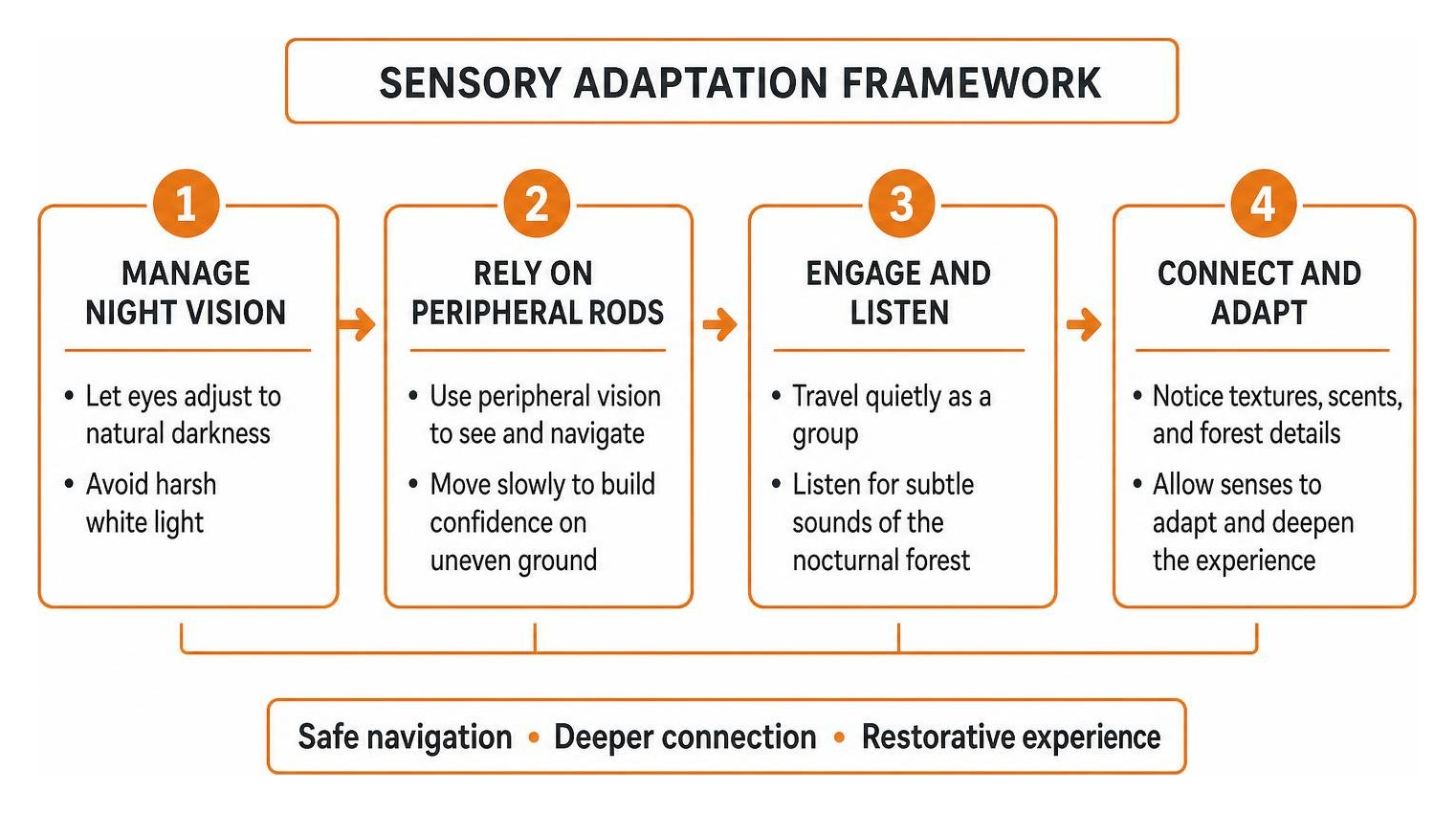
Our naturalists and experienced guides lead participants through specialized sensory adaptation techniques. During a guided night walk, leaders teach groups how to manage their night vision, avoid the blinding effects of harsh white light, and rely on their peripheral rods to navigate uneven forest floors. As detailed in our resource on The Ultimate Guide to Night Hikes, traveling quietly in a structured group naturally lowers conversational noise, allowing the subtle acoustics of the nocturnal forest to take center stage.
Self-guided walks along our well-marked, central pathways offer a complementary experience for personal reflection and quiet contemplation. When guests wander along designated pathways under the natural canopy, the absence of ambient chatter encourages deep introspection. Whether you are leading a youth group through team-building activities or offering executive teams a tranquil mental break, structured night programs at Alliance Redwoods ensure everyone enjoys the woods safely and responsibly.
Nocturnal Ecology and the Forest Atmosphere After Dark
The transition from day to night inside a coast Redwood grove brings dramatic microclimatic and ecological shifts. As the sun dips below the Pacific horizon just miles to our west, marine fog frequently rolls inland through the Russian River valley, blanketing the canopy in cooling mist. This coastal fog is an essential life source for the entire ecosystem, moderating temperatures and providing direct hydration during every season.
Coast Redwoods are masters of harvesting this atmospheric moisture. At night, the high needle canopy condenses fog into droplets that gently precipitate onto the understory below—a phenomenon known as “fog drip.” This process sustains the vibrant sword ferns, Redwood sorrel, and mosses that carpet the forest floor even during dry summer months, creating a lush, verdant understory that remains vibrant year-round.
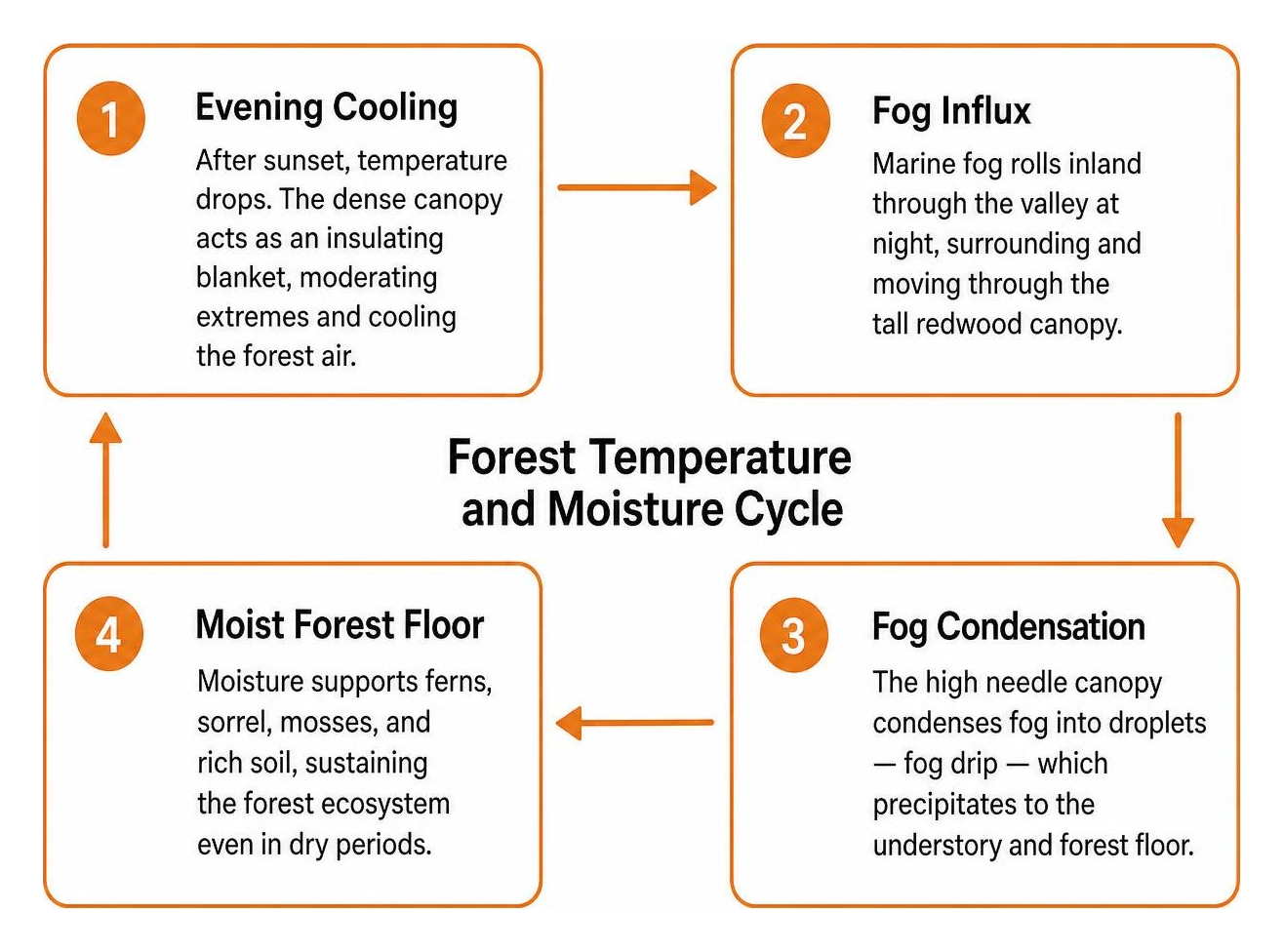
Along with shifting moisture levels, nighttime ushers in significant temperature drops. The dense canopy acts as an insulating blanket, moderating extreme temperature swings compared to open meadows, yet forest air consistently feels crisp, clean, and invigorating. This cool microclimate stimulates the nocturnal wildlife unique to Northern California’s coastal forests:
- Nocturnal Raptors: Northern spotted owls and barred owls navigate the tight upper branches with silent wingbeats, utilizing acoustic hunting techniques to track prey beneath the ferns.
- Canopy Mammals: Northern flying squirrels glide between ancient trunks, foraging on arboreal lichens and truffle fungi that thrive in the rich soil.
- Forest Floor Amphibians: Pacific tree frogs, California slender salamanders, and rough-skinned newts emerge from damp decaying logs once ambient humidity rises after dark.
- Moisture-Loving Invertebrates: Pacific banana slugs become highly active, grazing across damp fallen timber without the risk of daytime dehydration.
- Large Mammals: Native black-tailed deer quietly browse the understory brush, navigating established game trails with remarkable spatial memory.
Guided interpretation helps participants better understand the ecology of the coastal Redwood forest after sunset. Our educational team helps participants observe these species with minimal disruption to their natural habitats.
Capturing the Forest: Night Photography and Light Painting

Photographing Redwoods after dark transforms the pitch-black forest into a stunning creative canvas. During the day, direct sunlight filters through the canopy in patchy, high-contrast beams that can blow out highlights and cast harsh shadows across the bark. Night photography offers unique creative opportunities that aren’t available during daylight hours.
By setting up in a secure, open clearing within the forest at Alliance Redwoods, photographers can capture the vertical scale of the trees against the night sky or highlight intricate textures in the fibrous bark that are invisible under direct sunlight. Our dark-sky setting provides the ideal background for capturing celestial pathways, constellations, and the towering silhouettes of centuries-old trees.
Photographing Redwoods at Night: Astrophotography and Light Painting
Achieving sharp, balanced images of ancient Redwoods at night requires specialized photographic techniques and an understanding of light behavior in dense woodlands.
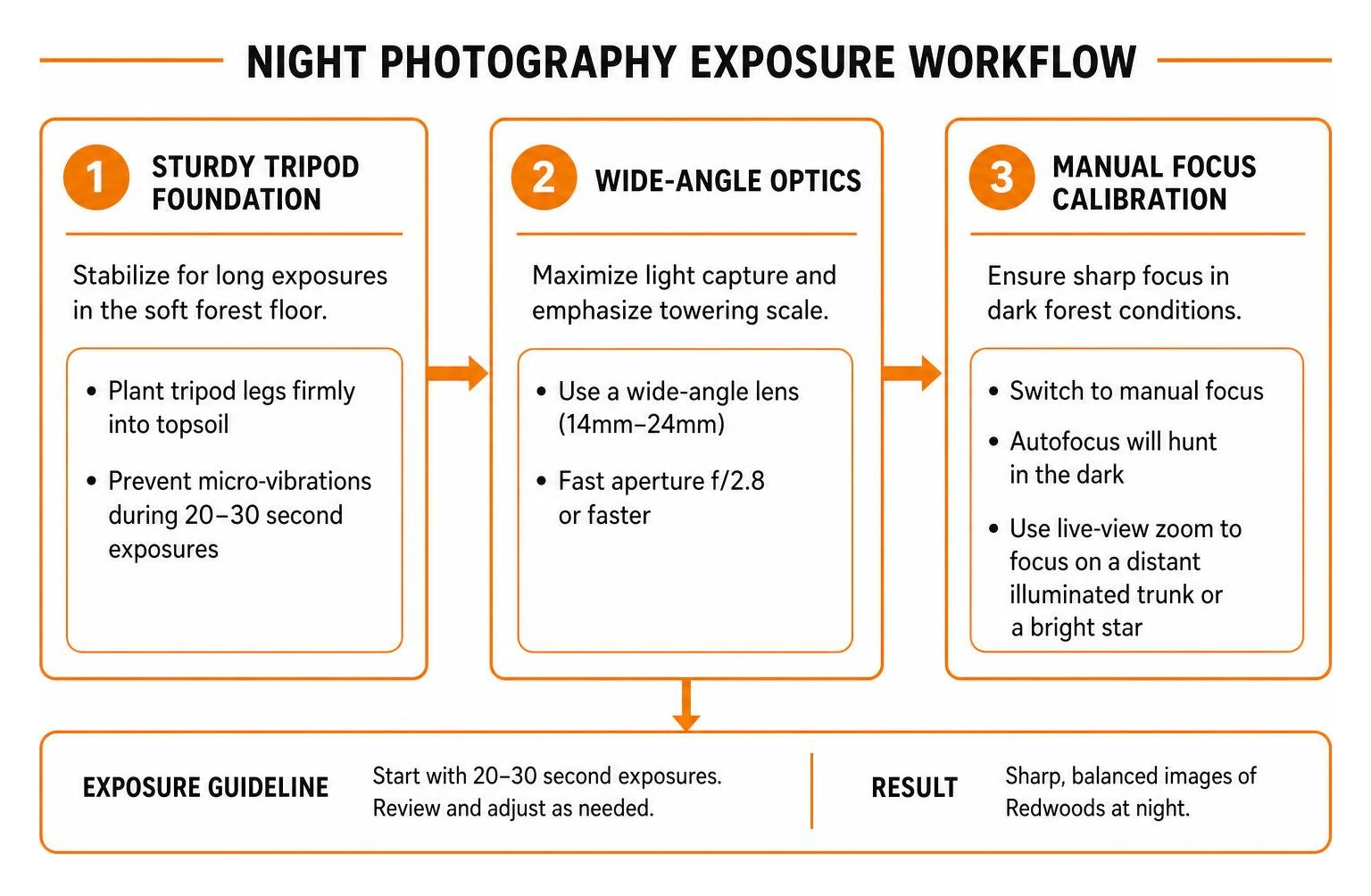
To capture stunning nocturnal forest imagery during your stay, follow these proven steps:
- Sturdy Tripod Foundation: Forest floors are soft and spongy. Plant tripod legs firmly into the topsoil to prevent micro-vibrations during exposures lasting 20 to 30 seconds.
- Wide-Angle Optics: Mount a fast wide-angle lens (between 14mm and 24mm) with a wide aperture of f/2.8 or faster. This focal length emphasizes the towering vertical scale of the trees while gathering maximum ambient light.
- Manual Focus Calibration: Switch your camera to manual focus. In dark forest conditions, autofocus will hunt indefinitely. Use your camera’s live-view zoom to manually focus on a distant illuminated trunk or a bright celestial star visible through a canopy gap.
- Balanced ISO and Exposure Time: Set your base exposure to ISO 1600 or 3200 for 25 to 30 seconds. This duration captures atmospheric ambient light and deep blue sky tones through canopy clearings without causing visible star trailing.
- Dynamic Light Painting: Avoid standing directly beside your lens with a light, which creates flat, uninspiring images. Instead, step several yards sideways to cast cross-lighting across the trunks. Cross-lighting accentuates the deep ridges, moss patches, and textural character of old-growth bark.
- Apply Warming Gels: Modern high-powered LED torches produce cold, bluish light temperatures. Affix a yellow or orange warming gel over your flashlight lens to render the warm, reddish-brown tones of the Redwood bark naturally.
- Mind the Inverse-Square Law: Light falls off rapidly over distance. When sweeping light across a scene, briefly brush foreground ferns for a split second, while lingering your light beam along the upper canopy trunks dozens of feet overhead to achieve even illumination.
Practical Planning, Logistics, and Trail Safety
Venture into the forest at night with thorough preparation. Forest trails present natural hazards such as exposed root systems, uneven terrain, and complete darkness. Establishing robust safety protocols ensures that every participant enjoys a safe, memorable adventure.
Before setting out, review our detailed guide on Night Hiking Safety with your group leaders. Walking in the dark requires distinct trail etiquette:
- Red-Light Discipline: Use headlamps equipped with red-light modes while trekking. Red wavelengths preserve natural night vision adaptation, allowing human eyes to perceive ambient forest textures without creating blinding glare for fellow hikers.
- Group Cohesion: Maintain a clear buddy system. The dense trunks and acoustic absorption of the forest can quickly isolate an individual who steps off the designated trail.
- Audible Pacing: Travel at a steady, measured pace. Encourage hikers to lift their feet slightly higher than usual to clear natural roots, stones, and fallen twigs.
- Stay on Marked Pathways: Protecting sensitive forest understories is essential. Staying on established paths prevents soil compaction around shallow Redwood root networks and keeps hikers safe from steep terrain drop-offs.
Essential Gear for Exploring Redwoods at Night
Equipping your group with the right gear ensures comfort, warmth, and safety throughout your night excursion beneath the trees.
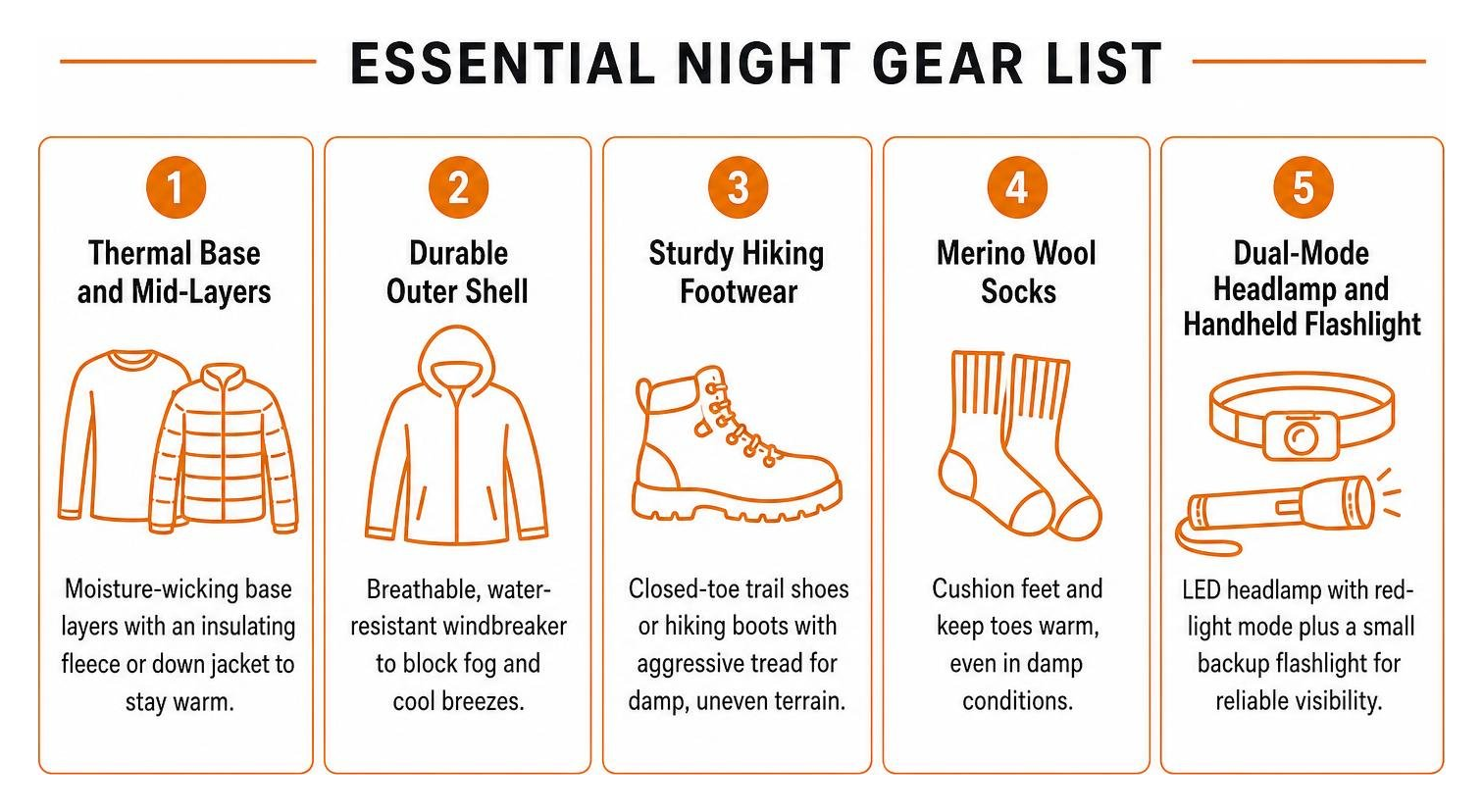
- Thermal Base and Mid-Layers: Coastal Northern California evenings cool down rapidly. Dress in moisture-wicking synthetic or merino wool base layers topped with an insulating fleece or packable down jacket.
- Durable Outer Shell: Bring a breathable, water-resistant windbreaker to shield against coastal fog drip and cool evening breezes.
- Sturdy Hiking Footwear: Wear closed-toe trail shoes or hiking boots with aggressive rubber tread to navigate damp soil, leaf duff, and slick wooden boardwalks securely.
- Merino Wool Socks: Cushion your feet while keeping toes warm even if damp trail conditions arise.
- Dual-Mode Headlamp and Handheld Flashlight: Carry a reliable LED headlamp with a dedicated red illumination setting, accompanied by a small secondary light source for emergency backup.
- Fresh Batteries or Power Bank: Cold night air drains lithium and alkaline battery life faster than warm daytime conditions; always pack spare power sources.
- Insulated Water Bottle: Stay hydrated with warm tea or water during crisp evening treks.
- Offline Communication and Whistle: Ensure group leaders carry whistles and offline communication radios or maps, as cellular reception can be limited deep within coastal valleys.
Accessibility, Booking Logistics, and Seasonal Considerations
Planning a visit to Alliance Redwoods requires advance coordination to match your group’s specific mobility, educational, and scheduling needs. Our private campus welcomes organized groups year-round, with distinct seasonal benefits:
- Summer and Early Autumn (June – October): Warm, dry daytime temperatures give way to crisp evenings with clear, starry skies overhead. This is our peak season for outdoor youth programs, church retreats, and corporate team building.
- Late Autumn and Winter (November – February): Dramatic coastal weather brings atmospheric fog, rain showers, and vibrant green mosses to life. The forest is quiet and deeply peaceful, offering an ideal setting for indoor-outdoor leadership conferences.
- Spring (March – May): Lush fern growth, surging seasonal streams, and mild evening temperatures provide a revitalizing environment for springtime school science camps and organizational retreats.
We take great pride in making our forest accessible to visitors of varying mobility levels. While primitive singletrack dirt trails feature natural roots and moderate inclines, our main central campus offers well-maintained pathways, paved connections, and ramp-accessible meeting venues and dining facilities. For families with young children, sturdy all-terrain strollers navigate our main gravel corridors smoothly.
Because we operate as a dedicated group retreat center, all night walks, rustic luxury lodging accommodations, and adventure programming require advance reservations. Booking early ensures your organization secures preferred dates, custom dining arrangements, and dedicated guide services tailored to your exact retreat goals.
Frequently Asked Questions About Redwoods at Night
Can you visit Redwood forests after dark safely?
Yes, visiting the forest after dark is remarkably safe when conducted on private, managed properties like Alliance Redwoods with proper preparation. Because unmonitored wilderness areas often present unmarked hazards, gated access roads, and unmanaged wildlife corridors after dusk, traveling within our private, monitored 115-acre facility provides crucial peace of mind. We maintain clear trail markings, comprehensive emergency response protocols, and trained staff who understand the terrain, ensuring your group enjoys the magic of the night woods in a secure, supportive setting.
What wildlife is active in Redwood forests at night?
The coastal Redwood ecosystem hosts a dynamic nocturnal community. Visitors at Alliance Redwoods frequently observe or hear Northern spotted owls, barred owls, and Western screech owls vocalizing through the upper canopy. On the ground, black-tailed deer graze along trail clearings, while Pacific tree frogs, California newts, and banana slugs navigate the moist leaf litter. High above the forest floor, Northern flying squirrels and bats forage silently among the branches, contributing to a vibrant, functioning ecosystem that thrives long after sunset.
What are the best times of year for nighttime Redwood stargazing?
Stargazing within the Redwoods depends on seasonal atmospheric patterns and canopy clearings. Summer and early autumn months offer prime conditions for viewing the core of the Milky Way through natural forest openings at Alliance Redwoods, particularly during new moon phases when celestial contrast is highest. Winter evenings bring exceptionally crisp, crystal-clear skies between passing coastal rain systems, offering stunning views of prominent winter constellations like Orion framed by ancient tree silhouettes.
What accommodations and facilities support nighttime retreats at Alliance Redwoods?
Alliance Redwoods provides fully equipped rustic luxury lodging, modern meeting spaces, and comprehensive dining services right in the heart of the forest. Groups can transition seamlessly from an evening night hike or stargazing session into comfortable, heated accommodations and state-of-the-art meeting rooms designed to support fruitful discussions, team building, and relaxation.
Conclusion: Transforming Your Perspective Beneath the Canopy
Stepping beneath ancient coastal Redwoods at night provides a transformative experience that daylight hours simply cannot duplicate. When visual distractions fade into darkness, your other senses awaken: the aromatic scent of coastal fog mingling with rich Redwood duff, the subtle whisper of evening breezes through high branches, and the profound stillness of an ancient ecosystem that has endured for centuries.
For decades, Alliance Redwoods has welcomed schools, churches, nonprofits, and organizations seeking meaningful retreat experiences among the Redwoods. Whether you are seeking outdoor science education for students, a focused planning session for your executive team, or a restorative spiritual gathering, our private 115-acre forest sanctuary provides the perfect balance of natural majesty, comfortable rustic luxury lodging, and intentional community.
Experience the Redwoods at Night for Yourself
The quiet beauty of the forest after sunset is one of the most memorable parts of any Redwood retreat. Whether you’re planning a church gathering, leadership retreat, outdoor education program, or private group event, Alliance Redwoods provides a peaceful setting where your group can experience the Redwoods at night through guided walks, outdoor learning, and meaningful connection.
Contact Alliance Redwoods to start planning your Redwood retreat and discover how an evening beneath the towering trees can become the highlight of your group’s experience.

