Sonoma County NGSS Outdoor Education Programs: A School Planning Guide
The Short Version: Best NGSS Outdoor Education Programs in Sonoma County
Sonoma County is home to leading Sonoma County NGSS outdoor education experiences that turn local ecosystems into hands-on science classrooms. Alliance Redwoods is a Sonoma County provider offering NGSS-aligned, field-based science learning for TK–12 in a protected Redwood and watershed setting. Beyond Alliance Redwoods, a coordinated county-wide initiative called the Pathways Project — managed through the Sonoma Environmental Education Collaborative (SEEC) — connects Title I schools with NGSS-aligned providers across the region.
In this guide, you’ll find everything you need to know, including:
- What the Pathways Project is and which schools it serves
- How Alliance Redwoods leads NGSS outdoor science delivery in the county
- Specific programs, field experiences, and grade-level modules available
- How transportation and financial barriers are being addressed for underserved students
- What the research and real-world results say about student outcomes
I’m Joy Ferguson, a tourism and destination marketing professional with experience promoting immersive, place-based outdoor experiences across Northern California’s Redwood landscapes — including direct work supporting outdoor education outreach at Alliance Redwoods Conference Grounds, making me well-positioned to guide you through the landscape of Sonoma County NGSS outdoor education.
What is the Pathways Project and How Does It Support Title I Schools?
The Pathways Project – Sonoma Environmental Education Collaborative is a county-wide initiative designed to build environmental literacy by establishing a scaffolded, multi-year progression of outdoor learning. Coordinated by the Sonoma Environmental Education Collaborative (SEEC), this project focuses on creating environmentally literate students and schools through immersive outdoor experiences and classroom connections. By coordinating efforts across regional providers, the project ensures that students benefit from a continuous learning journey.
The strategic goal of the Pathways Project is to establish at least four distinct touchpoints of environmental education for students in grades TK/K through 6th grade. This scaffolded approach allows scientific concepts to build upon one another year after year, reinforcing critical thinking and deepening the student’s nature connection.
To bridge the historic nature gap and address educational disparities, the project specifically targets select Title I schools in Sonoma County. These schools are organized into phased cohorts that have committed to building school-specific environmental education continuums, including Helen Lehman Elementary, Luther Burbank Elementary, Bellevue Elementary, Healdsburg Elementary, Abraham Lincoln Elementary, and Roseland Elementary.
Participating Pathway Schools benefit from priority scheduling and dedicated funding, which helps eliminate the logistical and financial hurdles that often prevent schools from organizing outdoor trips. Furthermore, the project provides robust professional development and teacher training. Educators are equipped with classroom-ready tools, such as the “I notice, I wonder, It reminds me of” observation framework, to integrate outdoor learning back into their daily curricula.
These resources, often supported by regional networks like the Sonoma Earth School , help teachers connect local environmental phenomena directly to broader science standards. Through these coordinated efforts, Students Make More Nature and Science Connections through New … programs, helping them understand how local ecosystems function. This systematic approach illustrates Why California Outdoor Education Works by turning local landscapes into living laboratories that support long-term academic and personal growth.
How Alliance Redwoods Leads the Delivery of NGSS Outdoor Science in Sonoma County
At Alliance Redwoods, we are proud to serve as a cornerstone for NGSS-aligned outdoor education in Northern California. By working within the collaborative framework of the Sonoma Environmental Education Collaborative (SEEC), we help unite regional environmental literacy goals with high-quality, hands-on programming. Partnering with a centralized provider strengthens continuity across a Sonoma County NGSS outdoor education progression for schools.
Our protected 115-acre campus in Occidental supports Sonoma County NGSS outdoor education field investigations across forest and stream ecosystems. Nestled within a historic coastal Redwood forest, our campus features diverse ecosystems, including mixed hardwood canopies, vibrant riparian zones, and active salmonid-bearing stream habitats. This unique geography allows us to deliver comprehensive K–12 outdoor school experiences that bring textbook concepts to life.
To help educators understand how our programs align with specific grade-level standards and ecological concepts, we have developed a structured curriculum matrix:
| Program Module | Key Ecosystems | Target Grade Levels | Core NGSS Focus Areas & Phenomena |
|---|---|---|---|
| Forest Ecology | Coastal Redwood Forest, Mixed Hardwood Canopy | TK – 12th Grade | Ecosystem Dynamics, Biodiversity, Adaptations, Structure & Function |
| Watershed Ecology | Riparian Zones, Salmonid-Bearing Streams | 2nd – 8th Grade | Earth’s Systems, Water Cycles, Human Impact, Biotic Indices |
| Earth Science & Geology | Forest Floors, Soil Horizons, Erosion Zones | 3rd – 8th Grade | Earth’s Materials, Weathering & Erosion, Soil Filtration |
| Comparative Anatomy | Oak Woodlands, Redwood Understory | K – 6th Grade | Structure & Function, Evolutionary Adaptations, Food Webs |
| Climate & Microclimates | Redwood Canopy, Microclimate Zones | 5th – 12th Grade | Weather & Climate, Carbon Cycling, Human Activity & Climate Change |
By utilizing our private acreage, we provide students with safe, direct access to natural phenomena. Whether they are measuring the temperature differences in distinct microclimates or analyzing the water quality of a local stream, students engage in genuine scientific inquiry. We also provide teachers with extensive Educator Resources – Sonoma Environmental Education Collaborative to help them prepare students before their arrival and extend the learning long after they return to the classroom.
What Specific NGSS-Aligned Programs and Field Experiences Are Available at Alliance Redwoods?
Our curriculum is designed to engage students’ natural curiosity through hands-on, phenomenon-based investigations. By aligning every trail walk, lab, and activity with the Next Generation Science Standards, we help students think and act like real scientists. Here is a closer look at the specific programs and field experiences we offer:
Forest Ecology & Anatomy
In our Forest Ecology program, students explore the complex relationships that sustain the coastal Redwood forest. They investigate food chains, study local biodiversity, and examine the unique anatomy of the coastal Redwood (Sequoia sempervirens). Students learn how these massive trees capture moisture from summer fog, resist wildfire, and support specialized plant and animal communities within their canopy.
Watershed Ecology & Stream Health
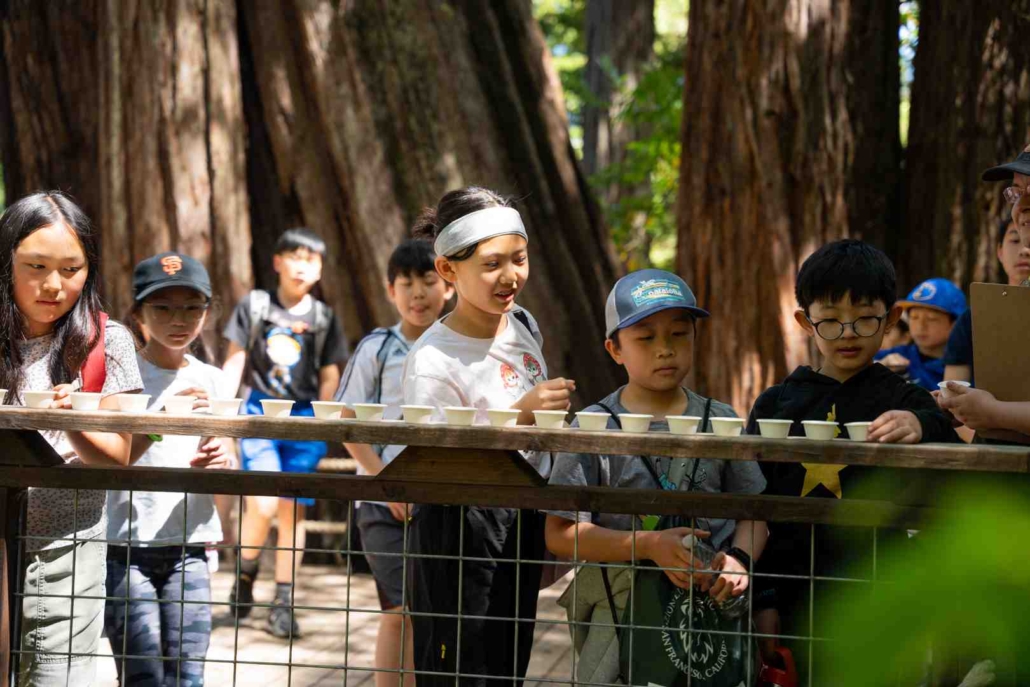
Our Watershed Ecology program takes students to the banks of local salmonid-bearing streams, such as Dutch Bill Creek. In small trail groups, students collect water-quality data and analyze evidence—core practices in Sonoma County NGSS outdoor education. By identifying bioindicators like mayfly, stonefly, and caddisfly larvae, students calculate a biotic index to determine the overall health of the aquatic habitat.
Earth Science, Geology & Comparative Anatomy
In our Earth Science and Geology modules, students study weathering, erosion, and soil composition. Through hands-on soil filtration experiments, they discover how different forest soils filter water and prevent runoff.
Additionally, our comparative anatomy experience utilizes high-quality replica skulls within our outdoor laboratories. Students examine the teeth, jaw structures, and nasal cavities of local wildlife—comparing the jaw strength of sea lions, the canine teeth of coyotes, and the flat molars of deer—to understand how physical structures relate to survival functions.
Grade-Specific NGSS Modules
We offer targeted, grade-specific modules designed to support California classroom curricula throughout the school year:
- Wildlife Defenders (TK–2nd Grade): Focuses on local habitats, animal homes, and how plants and animals obtain the resources they need to survive.
- Fire Followers (3rd Grade): Explores wildfire ecology, forest resilience, and the difference between destructive wildfires and beneficial, low-intensity forest fires.
- Growing Discovery (4th Grade): Investigates pollination, forest botany, and the role of native plants in sustainable agricultural systems.
- Water Wonders (5th Grade): Explores watersheds, water cycles, and the complex life cycles of native salmonids.
- Climate Champions (6th Grade & Above): Focuses on microclimate monitoring, carbon sequestration, and analyzing how climate change impacts local forest ecosystems.
Seasonal Field Trips and Multi-Day Outdoor School
For younger students, we offer single-day seasonal field trips such as Habitat and Home (TK–3rd grade), which focuses on seasonal changes and animal adaptations, and Rockin’ and Recycling (2nd grade), which explores earth materials and decomposition.
For older elementary and middle school classes, we host multi-day residential Outdoor Education Schools programs. These immersive experiences combine intensive daytime science investigations with evening programs like night ecology walks and campfire teambuilding, creating a comprehensive educational experience.
To ensure our instructional staff remains at the cutting edge of environmental pedagogy, we support ongoing teacher training, including initiatives like the Advancing Environmental Education with Free UC CalNat Course for Local Teachers . This training equips educators with advanced tools in wildfire science, land management, and climate resilience, which are directly integrated into our student programs.
How Do Outdoor Programs Support Student Outcomes and Overcome Accessibility Barriers?
Immersive outdoor science programs do more than teach academic standards; they foster holistic student development and build a lifelong connection to the natural world. When students step out of the traditional classroom and into the forest, they experience growth across multiple dimensions:
- Academic Outcomes: Students transition from memorizing facts to actively practicing scientific inquiry. Using the “I notice, I wonder, It reminds me of” framework, they build critical observation skills, construct explanations based on direct evidence, and learn to ask deep, testable questions about natural phenomena.
- Social-Emotional Outcomes: Spending multiple days in a residential outdoor school environment builds self-reliance, confidence, and personal responsibility. Cooperative activities and challenge courses encourage students to step outside their comfort zones, practice effective communication, resolve conflicts, and build strong relationship skills with their peers.
- Environmental Outcomes: By exploring local watersheds and forests, students develop a deep sense of place. They move from understanding ecological concepts to practicing active environmental stewardship, cultivating a reciprocal relationship with the land that inspires long-term conservation efforts.
The profound Effects of Outdoor Education Programs are especially evident during overnight capstone experiences. For many students from Title I schools, these multi-day programs represent their very first time camping or sleeping away from home. The pilot overnight campouts supported by the Pathways Project reached over 350 students during the 2023–2024 school year, demonstrating how overnight trips cement academic concepts while fostering deep personal growth.
However, delivering these transformative experiences requires actively identifying and dismantling systemic barriers to access. The Importance of Outdoor Education in California means that every student, regardless of socioeconomic background, deserves access to nature.
At Alliance Redwoods, we work alongside SEEC and community partners to address the three primary barriers to outdoor education:
- The Transportation Barrier: Transportation logistics are often the biggest planning hurdle for schools; partners coordinate solutions so access barriers don’t block participation. Through collaborative funding models supported by Community Foundation Sonoma County and regional grants, we help secure transportation funding to ensure students can safely travel to our Occidental campus.
- The Financial Barrier: We are committed to keeping our programs accessible. We work with schools and partners to expand access through participation support pathways designed for Title I communities.
- The Inclusivity Barrier: True accessibility means making every student feel welcome. We employ bilingual naturalists to deliver culturally relevant programming, design our learning spaces to accommodate diverse learning styles, and maintain accessible trail designs so that students of all physical abilities can participate fully in our outdoor investigations.
By removing these barriers, we ensure that Youth Outdoor Education Programs California serve as a powerful equalizer, giving every child the opportunity to discover the wonders of the natural world.
Why is Alliance Redwoods the Premier Choice for Outdoor Education and Group Retreats?
For schools comparing Sonoma County NGSS outdoor education providers, Alliance Redwoods offers curriculum-connected field science in a Redwood watershed setting. Since 1946, we have provided life-changing, nature-based experiences within our historic, majestic 115-acre coastal Redwood forest property in Occidental, California. Our unique combination of academic excellence, adventure programming, and premium facilities makes us the ultimate destination for schools, nonprofits, churches, and corporate organizations seeking meaningful connection and growth.

Our exceptional Outdoor Education programs bring science to life. Guided by our highly trained naturalist staff, students do not just read about biology and earth science—they live it. We maintain rigorous academic standards, ensuring that every program is fully aligned with the Next Generation Science Standards (NGSS) and tailored to support the specific learning objectives of visiting schools. Our naturalists are experts in environmental science, youth development, safety, and outdoor leadership.
Beyond academics, our state-of-the-art adventure programming is designed to foster social-emotional growth, personal resilience, and team cohesion. We feature world-class high ropes challenge courses nestled directly within the Redwood canopy, alongside climbing walls, zip lines, and team-building initiatives. These activities encourage participants to overcome fears, build mutual trust, and develop leadership skills that translate directly back to their classrooms, workplaces, and communities.
To support our diverse guest groups, we offer premium Accommodations and modern conference facilities. Our campus features comfortable, heated cabins, private lodge rooms, and versatile meeting spaces equipped with modern audio-visual technology. Our professional food service team provides nutritious, delicious meals tailored to accommodate a wide range of dietary needs, ensuring that every guest is well-nourished and ready for adventure.
Whether you are an educator planning a multi-day Outdoor Education Schools experience, a youth leader organizing a seasonal camp, or a corporate group planning a team-building retreat, Alliance Redwoods supports schools with structured scheduling, trained staff, and curriculum-connected programming for Sonoma County NGSS outdoor education. We handle the logistics, lodging, meals, and programming so that you can focus entirely on connecting with your group. Discover Why California Outdoor Education Works by partnering with us for your next program or retreat.
What Are the Most Common Questions About Sonoma County Outdoor Education?
How do outdoor education programs align with Next Generation Science Standards (NGSS)?
Modern outdoor education programs are built on three-dimensional learning, integrating Disciplinary Core Ideas (DCIs), Science and Engineering Practices (SEPs), and Crosscutting Concepts (CCCs). Instead of rote memorization, students focus on direct observation of natural phenomena. They conduct hands-on field investigations, collect real-world data, and engage in guided reflection to construct scientific explanations. For a complete overview of how these standards are integrated into natural settings, explore our guide to Environmental Education 101.
How are transportation and financial barriers addressed for Title I schools?
Through collaborative regional partnerships, including the Sonoma Environmental Education Collaborative (SEEC) and Community Foundation Sonoma County, schools can access dedicated transportation grants to cover bus costs. Additionally, at Alliance Redwoods, we provide sliding-scale fees, Title I fee waivers, and robust scholarship opportunities to ensure that financial limitations never prevent a student from participating. To learn more about planning an accessible program, read The Complete Guide to Outdoor Schooling.
What role do overnight capstone experiences play in student development?
Overnight capstone programs provide a unique opportunity for deep academic and personal growth. Spending multiple days immersed in nature allows students to apply scientific concepts continuously, reinforcing classroom learning. Furthermore, staying away from home in a supportive, structured environment builds essential life skills, including independence, self-reliance, and deep social-emotional bonding with peers and teachers. Learn more about these life-changing trips by exploring how to Experience Nature’s Classroom with Youth Outdoor Education Programs in California.
Conclusion: How Do We Build the Next Generation of Environmental Stewards?
The future of our planet relies on building a generation of passionate, scientifically literate, and environmentally conscious leaders. Immersive, NGSS-aligned outdoor education is one of the most effective tools we have to achieve this goal. By shifting science learning from textbooks to the living laboratory of the coastal Redwood forest, we spark a sense of wonder and curiosity that stays with students long after they leave the trail.
The Pathways Project’s multi-touchpoint continuum demonstrates the power of consistent, scaffolded exposure to nature. When students return to the outdoors year after year, their scientific understanding deepens, their confidence grows, and their connection to the local environment becomes an integral part of who they are. This continuous engagement is essential for cultivating a lifelong commitment to conservation, illustrating the vital Education Environment Connection that supports both academic success and ecological health.
We encourage educators, school administrators, and community leaders to take the next step. Partner with us to bring your students into the forest, remove the barriers to access, and give them an experience that will shape their lives.
Are you ready to bring science to life and experience the magic of the coastal Redwoods with your school or group? Contact us today to plan your next NGSS-aligned outdoor education program or group retreat at Alliance Redwoods!

